
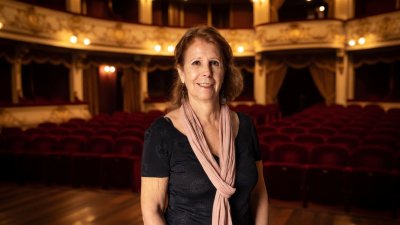
There is a geography that does not appear on the tourist maps of the islands. It is the geography of municipal venues at odd hours, the smell of old wood from dismantled stages, and the urgency to say something of one's own in a territory accustomed to consuming what comes from outside. At the forefront of this agonizing, tenacious, and profoundly necessary pulse for more than two decades has been a woman: Esther Vázquez.
From the seed of TEA to one's own trench
To understand the specific weight of Esther Vázquez on the island scene, one must look a little further back, remembering those pioneers of TEA (Teatro Experimental de Arrecife) who, much earlier, had already begun to stir consciences and give the first great push to the theatrical pulse in Lanzarote. Picking up that baton of resistance and love for the stage, Vázquez emerged as an essential driving force.
Far from the comfort of offices or large commercial structures, she has spent more than twenty years building a project outside of bureaucracy. For her, theater has never been a seasonal pastime, but an non-negotiable trench from which to write, direct, and sustain culture tooth and nail in a territory that has historically suffered from isolation.
A quarry of talent that forged the island scene
If Esther Vázquez's legacy were to be measured in numbers, it would fall short; it must be measured in names, in ignited vocations, and in consolidated talent. Through this inexhaustible quarry that she has nurtured for two decades, dozens of performers have passed through, who today sustain a large part of the dramatic pulse of the Canary Islands.
From this crucible of rehearsals and passion have emerged fundamental figures of the island scene such as Luis Garrido, José Ríos, Carmen Sancristóbal, Facunda de León, Virginia Barrero, Isidra Bolaños, or Juanjo Álvarez, among many others who found in this space the springboard and the school to develop their art. Under her direction, the stage has become a laboratory of honesty where identity and one's own voice are transformed into living material.
The curtain that never fully comes down
Sustaining an independent stage project for more than two decades on a non-capital island is not a matter of chance, but of unwavering faith in the craft. In an archipelago where culture is often consumed as a fleeting attraction, Esther Vázquez's trajectory defends the permanence of the day-to-day.
As long as there are curtains to lift and directors willing to risk it all in front of the blank page, the Lanzarote scene will continue to beat with its own rhythm, rough and profoundly authentic; the same beat they inherited from those first sparks of TEA and that a pioneer decided to keep lit against all odds.


Add La Voz de Lanzarote as a preferred Google source.
Stay informed with the latest current news.