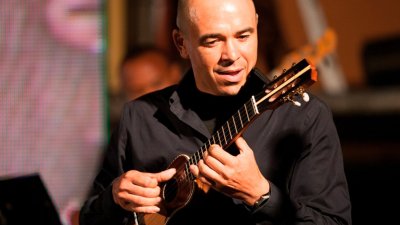
The musician from Lanzarote Alexis Lemes (1977) is one of the protagonists of the poster of themusician On May 9, at 8:30 PM, he closes the event with a concert in which he will take the stage accompanied by guitarist Javier Infante, with whom he has worked on his most recent production ‘Guiguan Project’, which also features double bassist Javier Colina.
Self-taught, Lemes perfected his technique within different groups and folk ensembles of which he was a part. His restlessness has led him down the path of other more contemporary styles such as jazz, although he acknowledges that popular music of roots is what continues to excite him the most. In the context of these modern sounds, his latest project, Guiguan, emerges, in which he is accompanied by Javier Colina, Javier Infante, and Markus Stockhausen.
Alexis Lemes, considered a contemporary exponent of the timple in the Canary Islands, bringing a fresh vision to traditional music, began playing at thirteen years old. In the group Los Campesinos, “which represents –according to the timple player– the essence of Lanzarote’s folklore, and which was a true school for me,” he was for three years, although, curiously, he played the guitar then. There he had don Juan Quintero as his teacher and shared the stage with many of the leading soloists of the Lanzaroteño folk scene. “At that time, I began to connect with the sounds that brought Cuban musicians to the Islands. This fusion enriched me greatly. We played together in many formats: trios, quartets. It was another form of learning,” he adds.
Inspired by the work in the nineties of other contemporary masters such as José Antonio Ramos (from whom he received classes), Benito Cabrera (who collaborated on his first album in 2016, ‘Día a Día’) and Domingo Rodríguez ‘El Colorao’ (with whom he has shared the stage), Lemes realizes the possibilities of the timple “They offered an unexplored dimension of the instrument by introducing different styles. While Cabrera innovated with the introduction of classical music and symphony orchestras, ‘El Colorao’ did so by betting on the pure essence of the timple, but at a masterful level”.
He has traveled with his timple the Canary Islands, the Iberian Peninsula, and a good part of Europe and, even, his music has been enjoyed live in Casablanca. In the concert he will offer in La Graciosa, sorondongos, tanganillos, seguidillas, and folías can be heard, along with other pieces sprinkled with influences closer to the avant-garde. "We will improvise and play with folklore," says Lemes.
Other proposals
Also on May 9, between 10:00 and 14:00 hours, the second edition of the Chinija Fair will take place in the context of the La Graciosa Timples Meeting, which will be held on Avenida Virgen del Mar in Caleta del Sebo, bringing together different artisans from La Graciosa and Lanzarote who will show the value of manual creation as a substantial part of cultural heritage.
The program of the XIII edition of the Encounter of Timples of La Graciosa, produced by Estudios Multitrack with the sponsorship of the Teguise City Council, Lanzarote Island Council, Canarian Institute of Cultural Development of the Government of the Canary Islands and Binter, to which Cicar and Líneas Romero collaborate, also includes a unique exhibition that, curated by Daniel Morales, offers on both days at the island's Socio-Cultural Center a diverse and complete selection of musical teaching manuals and methods, among which the ones developed by master Francisco Alcázar stand out, as well as a good number of historical records of folk music released in the Canary Islands, from those first vinyl records launched in the early 50s of the last century with music by Leocadio Machado, Casimiro Camacho, Andrés Macías, Juan Valerón or Totoyo Millares, to more current vinyl and CD formats. The exhibition can be visited from 10:00 to 13:00 and from 16:00 to 19:00.
The Timples Encounter of La Graciosa, promoted for the first time in 2013, has served to highlight the possibilities of the small string instrument in the hands of the best players belonging to different generations. Benito Cabrera, David Rodríguez “El Majorero”, Josele del Pino, Pedro Umpiérrez, Liana Llauger, David Duque, Alberto Delgado, Laura Martel, José Vicente Pérez, Fran Baraja, Achimencey Toledo, Félix Morales, or Domingo Rodríguez ‘el Colorao’ and his daughter, Julia Rodríguez, among others, have already passed through its stage.
The aforementioned musical event also presents itself as a participatory cultural proposal, where music, education, craftsmanship, and contemporary creation intertwine in a unique natural environment. An event that not only celebrates the timple, but also reinforces the commitment to culture as a living heritage, shared and in constant creative evolution.
All planned activities are free of charge.



Add La Voz de Lanzarote as a preferred Google source.
Stay informed with the latest current news.