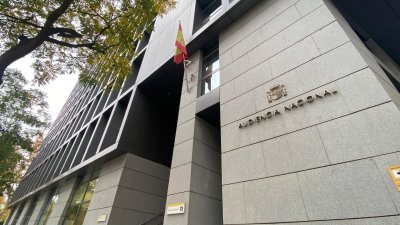
The National High Court has rejected paralyzing the case opened after the discovery of 2.3 tons of cocaine on a ship intercepted in international waters, which was heading to the Canary Islands and was transferred to Tenerife in August 2025, after calculating that the value of the seized substance with a purity of 84% is 76 million euros.
Last July, an oral hearing took place after one of the crew members, who is currently in prison, requested that the indictment issued at the beginning of this year be revoked, which has been rejected.
The defense alleged the absence of rational grounds for criminality and penal elements, while the Public Prosecutor's Office considers that there is evidence of the appellant's authorship in a crime of extreme gravity for the use of a vessel, another against public health, and one more of integration into a criminal organization.
On the surface, it appeared to be a fishing vessel flying the flag of Cameroon, but it was actually found to be making voyages between different points that had no relation to this activity, changing its name, and disconnecting its transmitter signal for long periods of time.
Drug trafficking by sea
All of this would be compatible with criminal acts and more specifically with drug trafficking by sea, to which would be added the fact that they lacked fishing gear and that the existing ones were only for fishing in the Mediterranean.
The crew of five people is considered insufficient to carry out this activity far from the coast, in addition to being located in the sub-Saharan region, known for its logistical problems and difficulties in controlling drug trafficking.
The collaboration of various police and customs agencies and organizations, along with the Civil Guard, concluded that their destination was the European Union (EU), which they intended to access through the Canary Islands, where the ship was heading when it was intercepted.
In August of last year, the ship was located and its five crew members were arrested. Their mobile phones, personal effects, and 80 bales with more than 2.5 tons of raw cocaine and 2.3 net tons after being analyzed in a Tenerife laboratory were seized.
From the dump of the mobile phones, it emerged that they used a WhatsApp group called "Friends," made up of users in Venezuela, Colombia, and the United Kingdom, through which they coordinated the delivery of "certain" merchandise and fuel that corresponded to the drugs.
In these conversions, it was concluded that the delivery was made about 500 nautical miles off the coast of Venezuela, and a list of patrol boats of different nationalities circulating in these areas was also found.
The hypothesis being handled in the National Court is that the ship first went to South America where it received the cargo, and then the intention was to deliver it to an organization responsible for these tasks that operates in Europe.
Add La Voz de Lanzarote as a preferred Google source.
Stay informed with the latest current news.