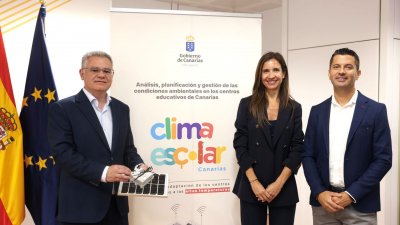
‘School Climate Canarias’ is an initiative included in the Plan for Adaptation to High Temperatures that has already allowed the installation of measurement sensors in 120 schools.
The program was presented this Friday, June 5, by the Deputy Minister of Education, Vocational Training, Physical Activity and Sports of the Government of the Canary Islands, José Manuel Cabrera, along with the Director General of Educational Infrastructure and Equipment, Iván G. Carro, and the project manager for Gesplan, Silvia Guajardo.
The project, promoted by the area headed by Poli Suárez, is pilot and unique in an autonomous community in Spain, and will bring these sensors to public schools in all municipalities of the Canary Islands, at different altitudes, allowing for real-time analysis of the impact of high temperatures and the study of their climate resilience as well as their design and habitability conditions.
The initiative also responds to two of the strategic objectives set by the Ministry for this legislature: improving student well-being and reinforcing the comfort and habitability conditions of educational spaces for the entire school community.
In this regard, the new network will provide objective and up-to-date information on the thermal behavior of Canary Islands educational centers to guide future improvement actions.
According to Cabrera, “with these devices we will be able to determine at all times the state of the centers where they are installed, and evaluate how extreme heat episodes, which unfortunately are becoming more frequent, affect the development of educational activity”. In this way, “we will be able to obtain information with which to define adaptation strategies that guarantee more adequate conditions of both thermal and environmental comfort”.
Operational platform for monitoring, analysis, and data management
To this end, along with the sensors, the project includes the development of an innovative web platform for monitoring, analysis, and data management, which will integrate information on buildings, geography, and vegetation, along with shade models and continuous monitoring systems of environmental parameters, such as temperature, relative humidity, and CO₂ concentration in these initially selected pilot centers.
The tool will allow for real-time analysis of the effects of thermal changes, support decision-making in contingency situations, and plan improvement actions in educational facilities.
In this regard, technicians will be able to access, quickly and centrally, information on the thermal and environmental comfort conditions of each center, as well as filter, evaluate, and prioritize possible actions more efficiently.
The project includes a synthetic analysis of the constructive and vegetation characteristics of the centers, with the aim of proposing interventions of different levels aimed at improving the habitability and comfort of educational spaces. Among other issues, it will facilitate the selection of nature-based solutions, such as the incorporation of adequate vegetation, as well as the identification of adaptation measures and specific interventions for each center.
One of the most relevant elements of the project is its capacity to evolve towards a predictive model, based on the continuous collection and analysis of data, allowing for the anticipation of needs, planning of future actions, and establishment of objective criteria for the progressive adaptation of Canary Islands educational centers to climate change.
Likewise, it will provide practical guidance to educational center managers on smaller-scale actions that can be integrated into routine maintenance tasks, as well as recommendations related to the efficient and adequate use of facilities.
The platform is already operational and receives real-time information from the 120 centers participating in this first phase of the project. For this purpose, 240 sensors have been installed, distributed between indoor and outdoor spaces of the educational facilities, which allow for continuous monitoring of parameters such as temperature, relative humidity, or CO₂ concentration, offering a precise snapshot of the environmental conditions of each center.
The information obtained through this network will not only allow us to understand the thermal behavior of educational centers but also to guide the adoption of measures adapted to each reality. Some of these may be applied directly by the educational centers themselves, while others will require broader actions by the educational administration, both in the short, medium, and long term.



Add La Voz de Lanzarote as a preferred Google source.
Stay informed with the latest current news.