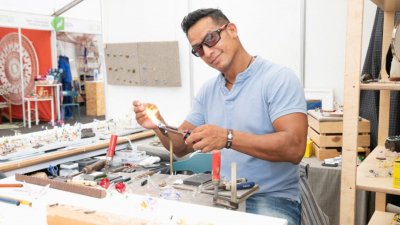
Alfredo Pineda was born in Mexico 47 years ago, but when he was only two years old his parents emigrated to Spain, first to the peninsula and then to Gran Canaria, where Pineda has spent most of his life, until nine years ago he decided to move to Lanzarote with his belongings and his glassblower business.
“My father already used to come to Lanzarote from the 90s every Sunday to the Teguise market with his glass pieces, so after some changes in my life I decided to come,” explains Pineda.
The glassblower trade has been in the family for a long time, Pineda learned it from the age of twelve with his father, who in turn had learned it from his grandfather, but at first he wanted to try his own path.
“I studied electricity and then physical education teaching, I worked in both fields and then tried other areas. I moved to England for a while and when I returned, ten years ago, I decided to focus on glassware,” explains Pineda.
The technique of woven and sculpted glass
Although Alfredo has also trained in blown glass, a much more widespread method, the Pineda family technique is not as well known and allows for smaller pieces, it is called ‘woven and sculpted glass’:
“Imagine two glass rods with a diameter of between 5 and 14 millimeters. One is used like a pencil and the other as a base. You put ‘the pencil’ into the flame of a torch and then it’s like you’re drawing in the air. You make small circles with the molten glass and that’s how the body of the figure is formed.”
In addition, some tools such as tweezers, pliers, punches or markers can be used to add more detail.
The glass that Pineda uses is called borosilicate and melts at between 1,200 and 1,300 degrees. The world’s best-known artistic glass, Murano glass, “melts at approximately 400-500 degrees, it’s different, it has a wider range of colors, which are more vivid, but it is less resistant.”
Memories, commemorations, and glass gifts
The master glassblower sells many pieces to tourists who want to take an original souvenir from Lanzarote that also fits easily in their suitcase: “a palm tree, a camel, the little devil of Timanfaya, the Canary lizard, little things related to the island.”
“In the 90s or even in the early 2000s we used to make figures perhaps over 30 or 40 centimeters because it was easier to transport on the plane, currently my figures are between five and 20 centimeters.”
Pineda also makes commissions “from collectors, for example of owls or giraffes”, or also for gifts or commemorations. “The other day they asked me for a heart for a wedding anniversary; on another occasion, a gentleman asked me for a flower to put on the grave of a person he had lost”.
Pieces, which although they may be similar, due to the characteristics of the artistic technique, are always different. Pineda's work can be found in “the markets of La Villa, Playa Blanca and Puerto Calero, I also go to the Mancha Blanca Craft Fair every year” and on social media.

Add La Voz de Lanzarote as a preferred Google source.
Stay informed with the latest current news.