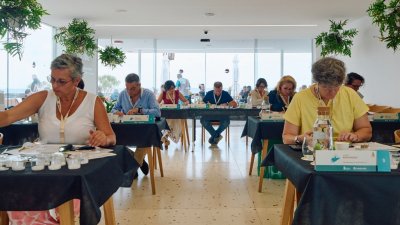
A total of twelve sea salts competed in Lanzarote in the eighth edition of the Official Agrocanarias 2026 Contest, organized by the Government of the Canary Islands, through the Canary Institute of Agri-food Quality (ICCA), with the collaboration of the Cabildo de Lanzarote, to recognize and promote the best productions of the Archipelago.
In this call, held at the Islote de Fermina this Thursday, September 17, productions from three saltworks in Gran Canaria and one each from Fuerteventura, La Palma, and Lanzarote participated.
Prior to the contest, a technical criteria unification session took place, aimed at standardizing the evaluation of the tasting panel, which, made up of specialists in the analysis of agri-food products, will evaluate the samples through a blind tasting system and determine the productions worthy of the grand gold medals and gold and silver medals.
Likewise, the distinctions of Best Canary Sea Salt, for the production that achieves the highest score; Best Canary Organic Sea Salt, among those registered with organic production operators; and Best Innovation, Image, and Presentation 2026 will be awarded.
The inauguration of the event was attended by the Minister of Agriculture, Livestock, Fisheries, and Food Sovereignty of the Government of the Canary Islands, Narvay Quintero; the Minister of Biosphere Reserve, Environment, and Climate Change of the Cabildo de Lanzarote, Samuel Martín; and the director of the ICCA, Luis Arráez Guadalupe.
During his speech, Quintero highlighted that “Canarian saltworks offer a high-quality product, obtained through artisanal and sustainable processes, closely linked to the territory and the conservation of environmentally valuable spaces.” The minister pointed out that there is still significant ignorance among consumers about the characteristics and quality of traditional sea salt, which is why “the Agrocanarias Contest contributes to improving the perception of the product by recognizing the best preparations and reinforcing its promotion and commercial positioning.”
Likewise, the head of the department highlighted that the commitment to complementary activities linked to sustainable tourism, outreach, and gastronomy represents an opportunity to improve the viability of the farms. “These initiatives generate additional income, favor direct sales, and allow us to convey the value of traditional sea salt and its production process to the consumer,” he explained.
The minister added that the Producers' Conference will allow for the sharing of experiences and the addressing of common challenges, including the possibility for the sector to promote a European differentiated quality seal for Canarian sea salt. “This recognition would protect the product, certify its origin and methods of obtaining it, and reinforce its differentiation in the market, as is already happening with other Canarian productions,” he concluded.
On the other hand, the director of the ICCA, Luis Arráez Guadalupe, highlighted that the competition and the producers' meeting allow for the combination of product promotion with dialogue among those who keep this activity alive. “This call allows us to distinguish the quality of Canarian salts, listen to their producers, share experiences, and identify common needs to continue strengthening the sector,” he noted.
For his part, Samuel Martín highlighted Lanzarote's close connection with the salt industry, an essential part of the island's rural tradition, agri-food production, and landscape. He also emphasized the value of initiatives like this for their contribution to the promotion of Canarian sea salt and for the boost that this valorization can provide for the recovery and exploitation of currently abandoned salt pans. In this regard, he pointed out that “the commitment to local products contributes to strengthening the food sovereignty of the Canary Islands and to conserving our unique landscapes.”
The labels and packaging of the awarded productions will be exhibited at the ICCA facilities until the next edition of the competition. Furthermore, the salt that obtains the distinction of Best Canarian Sea Salt Agrocanarias 2026 will be the subject of a report that will be published on the Institute's website and disseminated among general and specialized media outlets.
The awarded salts will be announced at a public event that will take place in the coming weeks. Likewise, the awarded companies will also receive public recognition at an official event scheduled for November.
Six active saltworks and nearly 2,700 tons of annual production
Canary Islands has six saltworks in operation: three in Gran Canaria and one each in Lanzarote, Fuerteventura, and La Palma, respectively. Together they occupy a total area of 309,000 square meters, of which 177,714 correspond to effective production area. Lanzarote concentrates 56% of the latter, followed by La Palma with 21%; Gran Canaria with 18%; and Fuerteventura with 5%.
Annual production stands at around 2,700 tons of sea salt. Traditional coarse sea salt is the main product of the six operations, which also produce fleur de sel. Additionally, fine salt, flakes, moist salt, salt blocks, and products for non-food uses are produced.
All saltworks carry out complementary activities related to outreach, tourism, and gastronomy. Five offer visits, workshops, or experiences and have their own shop; two have a cafeteria, another two a restaurant, and one houses a museum. These activities generate complementary income, favor direct sales, and contribute to disseminating the value of artisanal production.
Supermarkets and hypermarkets concentrate 41% of sales, and direct sales to consumers represent 38.1%. The remainder is distributed among producers—10%—, intermediaries and exporters—5.4%—, traditional shops and restaurants—4.7%—, and the internet—0.8%—. By markets, 53.9% corresponds to the local level, 30.3% to the regional, 7.4% to the national, and 8.4% to the international, although this last percentage also includes purchases made directly at the saltworks by foreign visitors.
Canary Islands Sea Salt Producers' Conference
In addition to the Official Agrocanarias Contest, the Government of the Canary Islands, through the ICCA, organizes the Canary Islands Sea Salt Producers' Conference, which is held between Thursday and Friday at the Janubio Saltworks.
The meeting brings together male and female producers, technical and research staff, institutional representatives, and entities linked to the sector to share knowledge, analyze their main challenges, and promote the professionalization, differentiation, and valorization of traditional Canary Islands sea salt.
With an informative approach and a format designed to promote participation and the exchange of experiences, the conference addresses issues such as specialized training, diversification and certification of traditional production, and the interpretation of heritage as a tool to publicize and enhance the value of the salt flats of the Canary Islands.
After the inauguration, the Head of the ICCA's Control and Certification Service, Domingo Afonso Martín, analyzed the current situation of the salt sector in the Archipelago. This was followed by the first thematic block, dedicated to training and innovation, with the presentations “The regulated training of salt producers in France. An example to follow?”, by Katia Hueso, researcher at the Institute of Salt Heritage and Landscapes, Red IPAISAL; and “Central Research Service of Salt of Hope. The role of the university in the innovation of salt products”, given by Macarena Castro, researcher and professor at the University of Cádiz.
The second block analyzed the professional challenges and opportunities of the sector through the presentation “The small salt farm from a complex legal perspective”, by biologist and salt farmer Manuel Ruiz, and the screening and subsequent discussion “Salt flats of the Canary Islands”, focused on the production and impact of the Televisión Canaria documentary.
The session concluded with the round table “Challenges and opportunities of the salt sector”, in which Luis Arráez Guadalupe, Katia Hueso, Macarena Castro, Manuel Ruiz, and Lidia Aldeguer, technical advisor for SEASALT Europe, participated.
The program also includes a guided tour of the Janubio Salt Flats, located in the municipality of Yaiza, and a tasting aimed at publicizing the characteristics of the different productions and enhancing the value of the traditional salt heritage of the Canary Islands, this Friday.
Add La Voz de Lanzarote as a preferred Google source.
Stay informed with the latest current news.