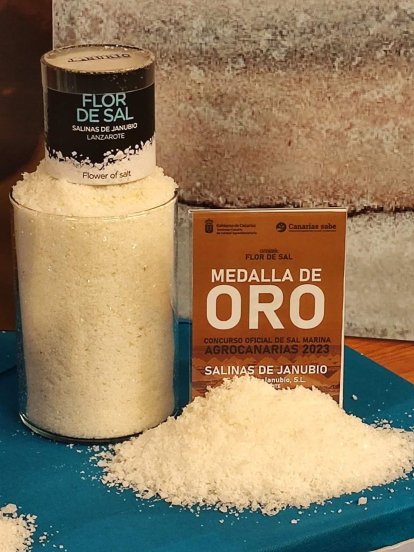
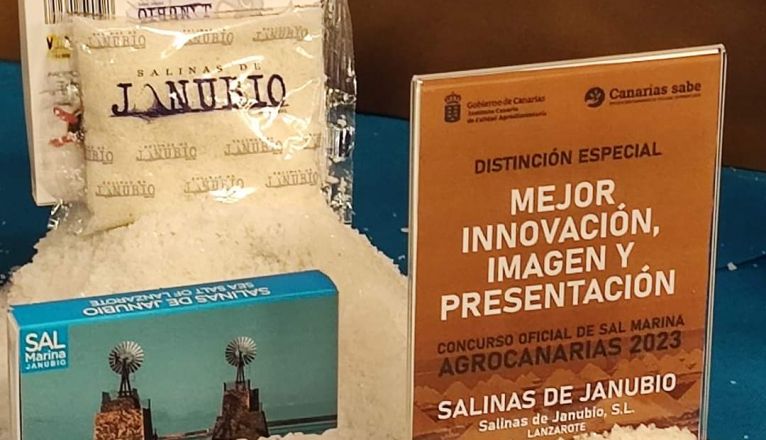
Salinas de Janubio from Lanzarote won the 'Gold Medal' in the 'Flor de Sal' category at the 'Official Agrocanarias Contest' held this Tuesday, November 14th. They also received another special distinction for the 'Best innovation, image and presentation', highlighting the lot format of 100-gram boxes with nine different images.
In the 'Virgin Sea Salt' category, the 'Gold Medal' was awarded to the 'Salinas Tenefé' brand, from Gran Canaria. While the 'Grand Gold Medal' went to 'Salinas Bocacangrejo', also from Gran Canaria.
The Area Councilor, Narvay Quintero, pointed out that the fundamental objective of this contest is to "make these productions from the Islands and the producing companies visible, and to recognize their quality and unique characteristics" through awards that constitute an "incentive" for consumers in their purchasing decision, and reinforce and promote the "commercialization" of the products that receive them.
The Minister of Agriculture, Livestock, Fisheries and Food Sovereignty, Narvay Quintero, and the director of the Canarian Institute of Agri-Food Quality (ICCA), Luis Arráez Guadalupe, who directed the act of reading the jury's decision of the contest, which in this edition had the participation of ten productions, six from Gran Canaria, two from Lanzarote, and two from Fuerteventura.
A tasting panel composed of eleven tasters, specialists in the analysis of agri-food products, have been in charge of selecting, under technical criteria and through the blind tasting system, that is, without knowing which production they are evaluating, the products that are awarded.
For his part, the director of the ICCA, highlighted during the contest, that the Institute "wanted to transfer the event to La Graciosa on this occasion, an island that had not previously hosted any of the Agrocanarias Contests, but that has a special link with the sea and a great salt tradition". "In Lanzarote there were up to 26 salt mines, among these, the 'Salinas del Río', the oldest in the Canary Islands, which were put into operation in the 16th century on a flat surface located at the foot of the Famara cliff, being separated from La Graciosa by the sea arm of 'El Río'", he recalled.


Add La Voz de Lanzarote as a preferred Google source.
Stay informed with the latest current news.