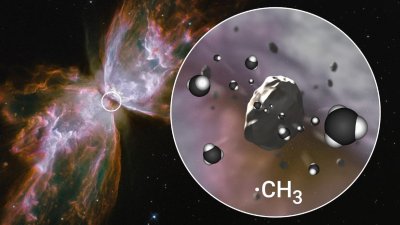
An international study led by researchers from the Instituto de Astrofísica de Canarias (IAC) has presented the first secure detection of the methyl radical (CH₃) in the environment of a carbon-rich evolved star.
The molecule has been found with the James Webb Space Telescope (JWST) in SMP LMC 011, a dying star in the Large Magellanic Cloud, and points to an unexpected pathway for building the carbon molecules that seed the Universe with organic material.
The results are published in the journal The Astrophysical Journal Letters, the IAC reports.
The methyl radical, CH₃, is one of the simplest and most important building blocks of carbon chemistry: a single carbon atom, three hydrogens, and an unpaired electron that makes it extremely reactive, so it bonds with almost any molecule it encounters, and this very reactivity makes it very ephemeral and very difficult to detect in space.
Furthermore, it is almost invisible to most telescopes, and due to its symmetrical shape, CH₃ does not emit a signal in the radio range where astronomers detect most molecules.
It can only be identified through a specific vibration in the mid-infrared, at a wavelength that the Earth's atmosphere blocks.
The IAC explains that through the MIRI (Mid-Infrared Instrument) aboard the JWST, the team not only detected CH₃ but also determined its abundance and found levels significantly higher than expected.
Normal chemistry, where ultraviolet light breaks down simpler molecules like methane, should only produce a modest amount of methyl, and according to the research, this excess suggests the existence of a previously unknown mechanism.
The researchers propose that dust grains themselves are the additional source, as around these stars, carbon and hydrogen condense into a disordered, soot-like material known as hydrogenated amorphous carbon (HAC).
The team suggests that this dust is being eroded by ultraviolet photons from the central star and/or shock waves, releasing methyl radicals directly into the surrounding gas.
A turn in the history of cosmic dust
The finding reverses the usual picture of how large carbon molecules (polycyclic aromatic hydrocarbons, or PAHs) interact with dust.
Normally it is thought that PAHs form in the gas and then get trapped in dust grains, but this result suggests that the opposite can also occur: grains can erode and return small, reactive molecules to the gas, where CH₃ then acts as a basic piece for assembling new ring-shaped (aromatic) molecules.
In practice, the team proposes a two-way feedback between dust and gas-phase chemistry.
This star is also exceptionally rich in benzene (C₆H₆), the simplest aromatic ring and the basic unit of PAHs.
No ethane
A second clue supports this interpretation, and that is that the team looked for ethane (C₂H₆), which would form if methyl simply reacted with itself, and did not find it, meaning that CH₃ is channeled into those growth reactions instead of reaching a dead end.
“The methyl radical is one of the most reactive and short-lived molecules we can look for in space, and it barely leaves a trace that telescopes can see,” explains Jialu Li, a postdoctoral researcher at the IAC who has led the study.
The co-author of the work, Domingo Aníbal García-Hernández, who also coordinates the European COST Action NanoSpace on carbon nanostructures in space, explains that the amount of methyl measured is too much to explain with usual gas-phase photochemistry.
“Evolved stars like this one are among the main factories of carbon dust and complex organic molecules in the Universe, the raw material for future stars, planets, and perhaps life,” states Arturo Manchado, a researcher at the IAC/CSIC and co-author.



Add La Voz de Lanzarote as a preferred Google source.
Stay informed with the latest current news.