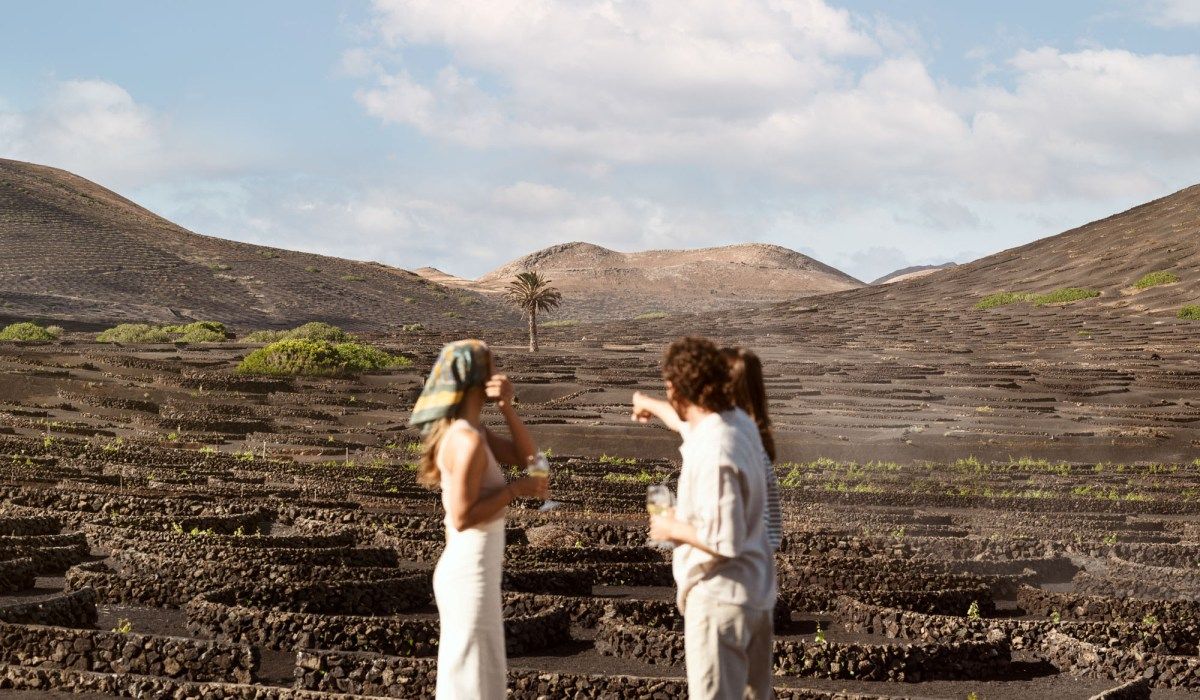
Lanzarote has not been fully known without having crossed its landscapes dotted with horseshoes and holes, nor without having tasted one of its wines. Lanzarote wines have achieved international prestige, but behind them there is a history of effort and adaptation to nature, in a priori hostile terrain for agriculture.
In arid soil, bathed by volcanic lava and unaccustomed to rain, the miracle of Lanzarote wines was wrought. As allies, the winegrowers had the trade winds, which condense the humidity from the ocean over the porous volcanic ash. But to achieve this, they first needed a mix of ingenuity and hard work.
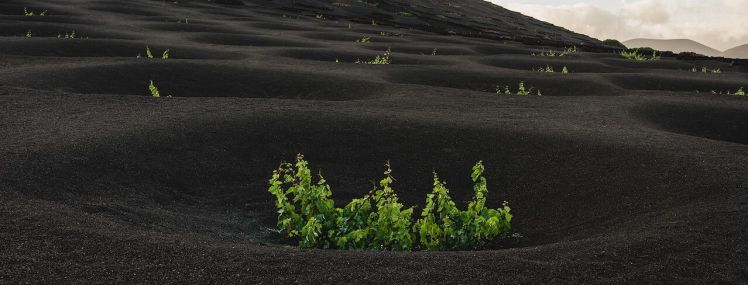
The key lay in those funnel-shaped holes that were dug into the volcanic ash layer, reaching close to the topsoil. Some are more than two meters deep, and they house between one and three vines, which are nourished by the dew retained on the ash and which filters into the soil during the day.
Around each hole, semicircular stone walls also had to be built to protect the vines from excessive wind. A titanic effort that not only contributed to the agricultural development of the island but also to shaping one of the landscapes that mark Lanzarote's identity.
Malvasía volcánica, Listán Blanco, Moscatel, Diego, Burra Blanca, Breval, Pedro Ximénez, Listán Negra, and Negramoll are the grape varieties with which Lanzarote wines are made.
The majority of the harvest is used for the production of white wines, whether dry, semi-dry, semi-sweet, sweet, liqueur wines, aged wines, and sparkling wines, although it is also worth highlighting not only the rosé wines but also the high-quality red wines.
The Regulatory Council of the Denomination of Origin Vinos de Lanzarote has more than twenty wineries registered, and some of them are open for visits. In addition, it is also possible to enjoy a wine tasting inside them, and even a meal among the vineyards.
The most emblematic area is located in La Geria, although it is not the only one. In total, Lanzarote has about 2,000 hectares under cultivation, each with its own charm.
La Geria: Vineyard area located between the municipalities of Yaiza and Tías. In La Geria, the pit system is used, due to the thickness of the lapilli or rofe layer, also called picón, which in some areas reaches up to 3 meters in height. This results in a lower planting density than in the rest of the island.
Masdache: Area located between the municipalities of Tías and San Bartolomé. The cultivation system is mainly pits, although the picón layer is thinner than in the La Geria area.
Tinajo: Vineyard area where the cultivation system is perimeter trenches.
Ye-Lajares: Area located in the municipality of Haría, although due to soil characteristics, it has low production.

Add La Voz de Lanzarote as a preferred Google source.
Stay informed with the latest current news.