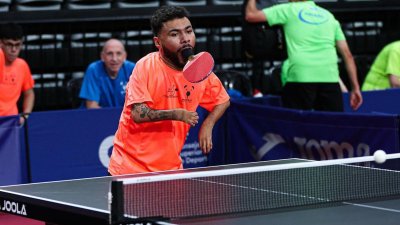
The athlete Anthony Fernandes (Lanzarote, 2002) has lived fighting since he was born. The young man suffers from congenital multiple arthrogryposis, which causes joint stiffness and lack of musculature, but this has never stopped him in his fight for his dreams. Fernandes is the first athlete to play table tennis with the paddle in his mouth and is now looking for a sponsor to allow him to compete in the Paralympic Games, something that has not been easy at all so far.
When he was born, doctors saw little hope that Anthony Fernandes would survive. "They told my mother that I was going to die and that if I lived a week it would be a lot, but my disability has nothing to do with living or not, it's just that the doctors didn't know," he says in an interview with La Voz.
During the pregnancy, his mother thought everything was going well, but it wasn't until she gave birth that she discovered her son had been born with this condition. "The doctors didn't know how to tell her until my mother asked to see me no matter what," Fernandes recounts. Initially, the doctors assured her that, if he survived, her son would only be able to move his neck and would have to use an electric wheelchair "for life".
Fortunately, this was not the case and his mother Zoila Casanueva fought from the very first moment to change her son's future and not resign herself to the initial diagnosis. From the beginning, his mother tried by all means to give the young man the best possible quality of life and thanks to that, Fernandes points out, "I am as I am and I don't live in an electric wheelchair".
His mother's fight to improve his quality of life
After that first diagnosis, his mother began to research to find hospitals where Anthony could be treated. The search took them to Madrid, Barcelona, and Valencia until she found a hospital in Germany specializing in rare diseases where they had a team specialized in congenital multiple arthrogryposis. "There they told my mother that with a therapy called Vojta, which they apply to all children there, whether they have a disability or not, from birth," explains the Lanzaroteño.
This physiotherapy method consists of stimulating the central nervous system to activate innate motor patterns by applying pressure to specific points. As it requires several very short daily sessions, physiotherapists teach parents to perform the exercises at home.
"They told my mother that if with that therapy in a year I didn't see any mobility, they wouldn't operate on me to be able to walk, but if I had mobility then they would operate on me to be able to stand up with prosthetics and a walker," he points out. The improvements soon appeared with the help of home therapies and, finally, he underwent that surgical intervention. After it, he recounts that "they would stand me up for five hours every day for rehabilitation."
Fernandes and his mother also lived in Chile for a year and a half to attend a specialized therapy center. In total, throughout his life, the Lanzarote native has undergone twenty operations. "Every time I had to have surgery, my mother would reward me in some way because, so as not to miss class, they would operate on me in the summer," he points out. "On my birthday, my mother would try to save a little more and give me a surprise to compensate," he continues.
A happy childhood despite bullying
On many occasions, children with a condition can suffer exclusion firsthand. Anthony Fernandes suffered school bullying, but despite this, he assures that he had "a very good childhood."
It was at the end of Primary school when the young man suffered these episodes of school bullying. "I thought I had a very strong mind because my mother had worked very hard on it, but it is true that it affected me and I started to get lower grades at school," he recalls. However, when he moved on to high school, the bullying stopped when he separated from his bully.
"Before I could speak, I already knew how to say my name and that I had congenital multiple arthrogryposis, and adults you tell it to at first don't know how to say it. My mother normalized it a lot and told me that I was like that and that I needed help for many things, but I could lead a normal life within the limitations," he declares.
Table tennis, his great passion
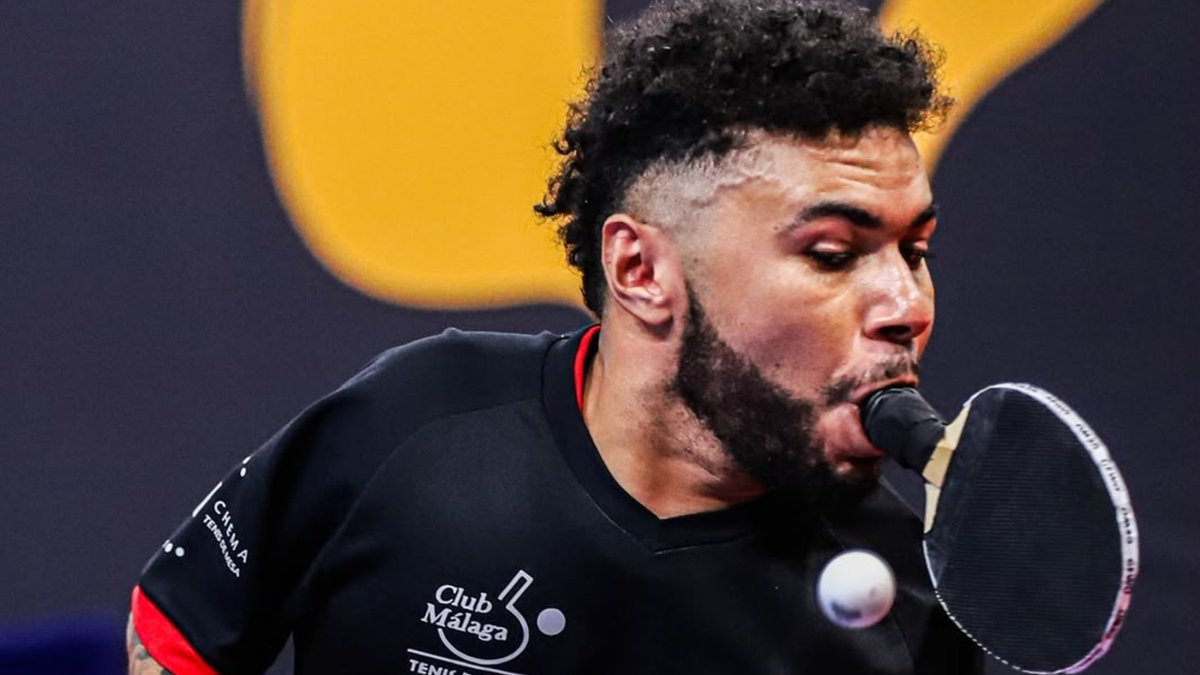
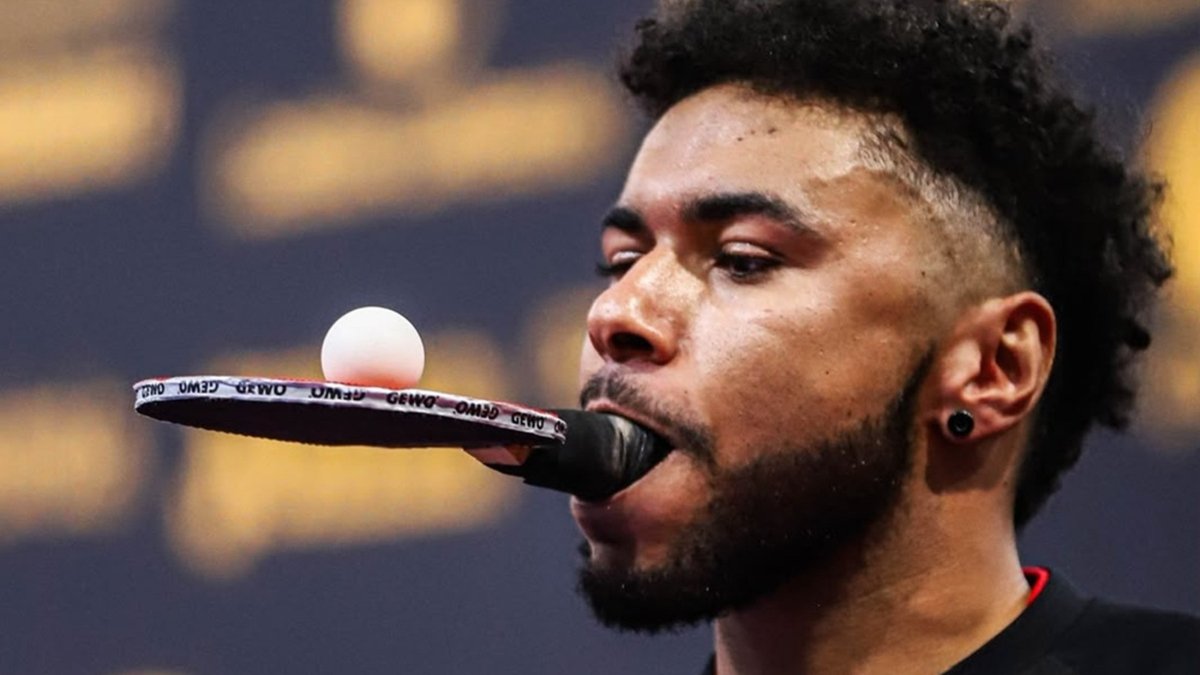
Anthony Fernandes started playing table tennis by chance at the age of ten. One day at his school, he went out to the playground and saw some children playing this sport on tables they had put together and a retractable net. "They offered me to try, I picked up the paddle with my mouth and tried to do something, to hit the ball at least, and it was horrible," he recounts with a laugh. However, from that day on, he discovered that he liked it and began to practice daily with the help of internet videos.
"I gradually created my technique," he points out. And it is that his unique technique of holding the paddle with his mouth attracts a lot of attention. "To this day, competing nationally, I am still learning to play because with my coaches we look for new ways to be more effective and hit the ball better," he indicates.
His coaches, seeing him play from the outside, assure that this technique of hitting the ball and moving his neck, "is cleaner than that of a person using their hand." In the beginning, he confesses, his goal was swimming, but "things went sideways towards table tennis."
The talent and effort of the Lanzaroteño has led him to achieve a fourth place in the Spanish Table Tennis Championship last June, his best position to date. Now, he is preparing to make the international leap soon.
This is one of the many reasons why many see him as a role model. "People say I am, but all I do is live my life, it's just that I do things with my mouth and that attracts a lot of attention, and I don't stay at home hiding, but rather I show it," he reflects.
Seeking sponsorship for the Paralympic Games
The young Lanzaroteño is now immersed in a clear objective: to participate in the Paralympic Games, although he acknowledges that "there is still a long way to go." In fact, a few days ago, Anthony Fernandes made a post on his social media networks a request to find sponsors to support him on his path to the games. "I've been looking for sponsors on my own for a long time and there was no way because they didn't respond or told me I didn't fit the profile when it came to a ping-pong brand," he says.
In this post, he asked people to follow him on Instagram to reach the 15,000 or 20,000 followers that one of the companies required to sponsor him. When he launched this campaign, Fernandes had just over 3,000 followers and now he has reached over 35,000. Support that, without a doubt, he did not expect. "It's crazy, honestly I expected to get a response, but not this much," he indicates, surprised.
The sponsor plays a vital role in the career of an athlete in this type of competition. They are responsible for covering plane tickets, per diems, training, or registrations, that is, the essential elements to support the growth of athletes.
Thanks to this social media post, the Lanzaroteño has received several offers from brands and companies to offer him sponsorships. "Many people have spoken to me because they want to help me and there are other brands that are interested," he concludes.
Add La Voz de Lanzarote as a preferred Google source.
Stay informed with the latest current news.