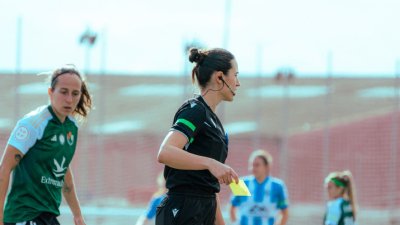
The Lanzarotean Ágata López García (Arrecife, 1995), has managed to move up to the women's first division this 2026/2027 season, being the first to achieve it, both on the island of Lanzarote and provincially.
In 2006, at the age of 11, she joined the referees' committee, an act that has led her to the top. In 2020, the Technical Committee of Referees chose her for promotion tests, but an unexpected injury prevented her from doing so. Now, after 4 seasons in the women's second division, and three in the men's third RFEF, she has managed to move up to Liga F, the top category of women's football.
You started refereeing at eleven years old. What motivated you to become a referee at that age?
At eleven years old, I took the introductory refereeing course, which all referees have to take to start refereeing, and at twelve is when I refereed my first federated match. What motivated me was seeing my cousin, who was also a referee. We are only two or three years apart, and being of similar ages and seeing him referee, I really liked it and it motivated me.
Do you remember your first match as a referee and how did you experience it?
I remember it, as I mentioned before, my first match as a referee in an official federated competition match was when I was twelve years old, but my first real match, not federated, but a friendly summer tournament match, was in Tinajo and I was still eleven years old. I don't remember if it was the Benjamin or Pre-Benjamin category, but anyway, I was very nervous and lost at first, I was accompanied by my parents, so I was happy.
At that age, did you imagine you would reach where you have reached?
Not at all. I didn't even consider it, it's not that it was a dream I thought I wouldn't achieve, but it wasn't even in my mind as a goal because at that time we didn't have any role models, female referees in high categories, nor did that category exist, which is now the first division that is professionalized and has resources, which are still lacking, but there wasn't that goal even to dream about it, so, not at all.
Why a referee and not a player, when it's more common?
As I told you before, because of family. It's true that with my cousins I used to go to the football field to take shots and stuff, but I wasn't really good at it, so, better a referee.
In the world of football, there have always been many criticisms of referees, especially female referees, how do you experience it? Have the criticisms affected you or do they affect you during a match?
I think that, in general, the figure of the referee is criticized, whether you are a man or a woman, it is true that then as a woman you have the summation that is sexist and in the end you have those insults or those comments that go beyond the insult that a man might receive, but that men also suffer from that verbal violence on a football field.
Starting from that, what refereeing has helped me a lot with is learning to manage all those emotions because in the end you cannot get infected by the stands, nor by the players, nor by the coaching staff on the bench. So, it has been a process that I learned as a child thanks to the support of my parents at that time and all my colleagues in the collective, I sustained myself. But at first it was a process that had to be digested because in the end a person is not really used to exposing themselves and being insulted. So it has been a learning process and now it really doesn't affect me at all.
When was the moment you thought you could turn it into your job and it wasn't just a hobby?
Well, I really think I still can't grasp the idea that refereeing is my profession right now because it's something that, as I said before, I hadn't considered for a long time and it's true that, a few years ago, the women's category became professionalized and many of my colleagues are now living off it and the dream they've had for years. So right now I even find it hard to process that this will be my job.
You took a break to focus on your academic life, how was that?
Well, let's see, I took the break, which was really a half-break because where I went to study I continued refereeing, it was because I went to study in Madrid, and there the first year, since I didn't know how I was going to adapt to university, I put refereeing on standby. Since I adapted well to the two degrees I was doing at the same time, the second year I decided to get federated.
I was refereeing there in Madrid, and by refereeing that second year, it's true that I realized that the academic workload I had with the university, I had a lot of exams and work. In the third year, I had to put it aside again, refereeing, to be able to get my degrees, and once I finished university, I returned here to Lanzarote and got federated again.
Once you graduated, was it clear that you were going to be a referee, or did you also have in mind to practice what you studied?
As I told you, as soon as I finished, I came and registered, I had no doubts. Besides, when I was at university without refereeing, really when I came back here to Lanzarote I would meet up with my colleagues from the collective, I would meet with them and go to summer classes to find out about the game's updates. Really, in those years when I wasn't refereeing, I was still linked to the committee and had zero doubts that when I finished my degree I was going to referee again. What happened? That I have always thought that this is a hobby, that it is true that I have always taken it with great commitment and responsibility and these are the fruits, I always thought about combining my professional work with refereeing.
You had an injury in 2020, just when the proposal for the promotion tests to the first division came up, did you think about quitting, or did having the opportunity so close motivate you to try to achieve it again?
No, I never considered quitting. In the end, if this opportunity presented itself, it's something I never imagined or dreamed of, and I'm not refereeing, nor have I ever refereed, to achieve this goal, but rather I have always refereed because I like football, I enjoy it a lot, the feelings I have when playing are incredible. So no, I never considered it because that was not my goal in my sporting career either.
What does it mean to you to be the first female referee from Lanzarote and the province of Las Palmas to be promoted to the first division?
Well, the truth is that it's a source of pride, an honor, and I'm very grateful because in the end, although it's often said that refereeing seems like an individual sport, it's actually a team sport, where you work with male and female colleagues, and to be here, the truth is that I needed the support of all of them, and especially also, of my family.
We have seen that this World Cup had the first all-female refereeing trio, what does that mean to you as a colleague in a profession where, thinking positively, you could aspire to reach that competition?
Well, the truth is that they inspire me and I feel absolute admiration for them because I know, from my own experience, how complicated it is to climb the ranks in the world of football and refereeing as a woman.



Add La Voz de Lanzarote as a preferred Google source.
Stay informed with the latest current news.