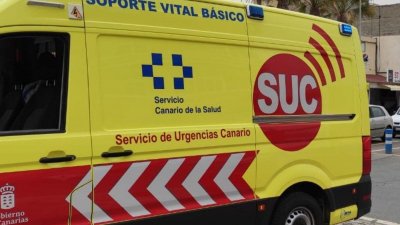
USO-CANARIAS publicly denounces the "increasingly unbearable" situation that Health Emergency Technicians (TES) are enduring as a consequence of a high care pressure, a significant workload, and emotional wear and tear that has been prolonged over time without structural solutions being adopted.
Jonathan González, provincial head of Health Transport for USO-CANARIAS, warns that professionals are reaching a worrying state of physical and emotional fatigue, caused by working conditions that subject staff to ever-increasing pressure daily, to the point of enduring more than 14 hours without being able to eat.
Added to this reality is the state of a very deficient and aged ambulance fleet, with vehicles that in some cases accumulate more than 600,000 and 700,000 kilometers, and with resources that become inoperative practically daily due to breakdowns, deficiencies, and lack of adequate maintenance.
"We cannot normalize that those who have the responsibility of attending to and transporting patients in situations of illness, emergency, or special vulnerability have to carry out their work with vehicles extremely worn out by use and with equipment that, in many cases, shows evident deterioration," they state.
The condition of the vehicles is not solely a labor problem for the professionals. USO-CANARIAS believes that "it must also be addressed from the perspective of the quality and safety of the public service that citizens receive."
More pressure, more sick leave, and less response capacity
Sustained care pressure is having direct consequences on staff and the administration looking the other way. In addition to the daily overload, there are continuous sick leaves, which further increase the pressure on the professionals who remain operational.
A "hardly sustainable" cycle is being generated: more workload due to a public contract that has expired and been extended twice, greater exhaustion, more physical and emotional pressure, and an increasingly strained staff.
"TES have been sustaining the structural deficiencies of the system with their professionalism and commitment for too long. But vocation and professional responsibility cannot become the tool used to indefinitely compensate for the lack of resources, maintenance, and planning," they argue.
A new tender that continues without offering an immediate short-term solution
USO-CANARIAS also expresses its "enormous concern about the lack of an immediate solution related to the future public tender for health transport".
"Current expectations do not allow for structural renewal in the short term while the population continues to grow and there is a risk that the situation could be prolonged for approximately two years or more, while professionals continue to work with an aging fleet subjected daily to enormous demands," they warn.
"We cannot wait two years or more looking the other way. The competent administrations must establish urgent transitional measures that guarantee maintenance, the replacement of vehicles that have reasonably exhausted their operational life, the availability of sufficient resources, and adequate conditions to carry out the activity," they demand.
USO-CANARIAS calls on public administrations and the companies responsible for the service to "act urgently to address the care overload, the physical and emotional fatigue of the TES, continued absences, fleet maintenance and renewal, and the deterioration of health and operational equipment".
They also consider it "essential to reinforce occupational risk prevention measures and pay special attention to psychosocial risks derived from continuous care pressure".
“We Health Emergency Technicians are exhausted from sustaining a system that demands more from us every day while we work with fewer resources and with vehicles that accumulate hundreds of thousands of kilometers. We are not only talking about working conditions; we are also talking about the safety of professionals and the quality of the service we provide to citizens," they assure.
USO-CANARIAS will continue to denounce this situation and defend that Health Emergency Technicians can exercise their profession with dignity, safety, adequate resources, and the recognition that an essential group within the health system deserves.
Add La Voz de Lanzarote as a preferred Google source.
Stay informed with the latest current news.