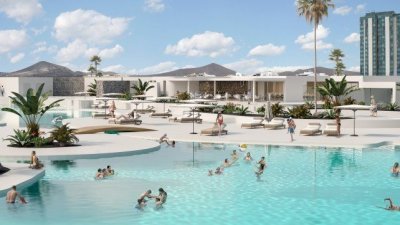
More than a decade after the culmination of multi-million dollar works on the Islote de la Fermina that were never even inaugurated, the Cabildo has announced the start of the new project to try to recover this space. However, for the moment work will begin inside the existing structures, as permission has not yet been received from Costas to act in the outside area.
The Fermina project, in which the Cabildo, the Arrecife City Council and the Centers for Art, Culture and Tourism are working together, aims to "return to the people of Lanzarote one of the most emblematic spaces in the Arrecife marina", according to the Island Corporation. To this end, last Friday the last permit was received from the capital's Consistory, after having also obtained authorization from the Canary Islands Coastal Demarcation, although only for a first phase.
As explained in a statement, the basic building project of the Islote de la Fermina "will allow the execution of repair, consolidation, improvement and modernization works of the existing structures without increasing their surface area, volume or height". Thus, among the works to be carried out are "the demolition of the interior partitions and the construction of new ones for the redistribution of the interior spaces; the creation and repair of reinforcements in metal structures; the tiling of bathrooms and pavements; the repair of the roofs and the installation of new false ceilings, as well as carpentry in doors and windows and general installations, among others".
"Buried under decades of neglect and oblivion"
Both the Cabildo of Lanzarote and the Arrecife City Council have expressed "deep satisfaction" for the beginning of a project that, in the opinion of the president of the First Island Institution, Pedro San Ginés, "unlocks an old desire of the population of Arrecife, restores one of the most important spaces of the city, buried under decades of neglect and oblivion, and transforms the physical appearance and the way of thinking of Arrecife".

For her part, the Mayoress of Arrecife, Eva de Anta, considers that "Arrecife needs to relearn to enjoy its coastline, to use intelligently all the possibilities offered by a unique marina that, to this day, continues to offer possibilities of use pending exploration". "Faced with those who proposed the privatization of the Islote, we have opted to go hand in hand with a public company. We believe that the use of a space of such a singular nature cannot be carried out with a merely economic or short-term criterion", said the mayoress, referring to the project that was proposed to make a private aquarium in the Islote.
The councilor of the Centers, Echedey Eugenio, assures that "we are beginning to make visible a project that should be an example of how administrations work together and in a coordinated manner for the benefit of citizens". Eugenio affirms that he is "absolutely convinced that Fermina will be an element that will drive the transformation of Arrecife, in particular, and of Lanzarote, in general, which will restore the pride of being and living in this capital. It will bring a plus of modernity and open the doors of the future to this island". "I am sure", concludes the councilor, "that it will become a cohesive and vertebrating vehicle that will restore to the population the pride of being and living in Arrecife".
A budget of almost 1.4 million
The total budget of the Fermina project amounts to 1,388,115.92 euros, charged to the Canary Islands Development Fund (Fdcan) managed by the Planning and Coordination Unit of projects of the Cabildo of Lanzarote coordinated by Saray Rodríguez.
Meanwhile, the Cabildo, the Centers and the Consistory "remain waiting to receive the relevant resolution, also from Costas, to start the intervention in the outer areas, which are not currently under concession", according to the press release.
"Presented in June 2017, Fermina contemplates converting this currently deteriorated space into an element that dynamizes the tourist activity of Lanzarote based on nautical leisure linked to the sustainability of the sea, technological innovation and talent", they recall from the Cabildo.
Add La Voz de Lanzarote as a preferred Google source.
Stay informed with the latest current news.