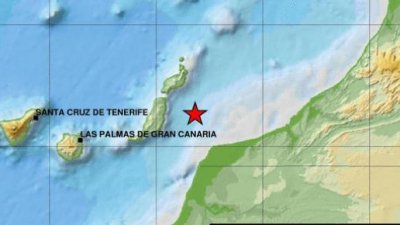
The risks involved in oil activity are increased in the case of the Canary Islands, due to the frequent presence of seismic movements in the area where the prospecting will take place. In fact, the National Geographic Institute made several "observations" on July 17 to the document presented in June on this subject, called "Monitoring system of seismicity induced by drilling".
In the Industry resolution published this Wednesday in the BOE, definitively authorizing the surveys, it is pointed out that the content of this document is "mandatory", "without prejudice to the fact that its content must be adapted to the observations sent on July 17, 2014 by the National Geographic Institute". In addition, it makes it clear that the movements that are usually recorded in this area of the Atlantic are added to those that can be generated by the surveys themselves.
In this regard, the resolution indicates that it will be necessary to install "at least one accelerometer on the island of Lanzarote and another on that of Fuerteventura, also considering necessary the installation of OBS prior to the execution of the project, in order to guarantee the quality of the signal emitted". In addition, it adds that "for the purposes of applying the protocol, the reference radius around the borehole is set with respect to the location of the epicenter of a possible earthquake at 20 kilometers".
Area of frequent earthquakes
Regarding the natural seismicity that already exists in the area, the resolution indicates that in the event of a seismic movement greater than 4.5 degrees, "with the epicenter in a radius of 75 kilometers around the borehole, the drilling operations will be stopped, placing the borehole in safety".
In the event of this situation, the operations "may not be resumed until the integrity of the borehole is verified". Regarding how they will obtain the data, "both magnitude and location of the epicenter", the resolution indicates that "they will be provided by the National Geographic Institute, coming from its seismic network in the Canary Islands, enabling the appropriate contact points". It should be noted that there are currently no methods to predict when a seismic movement will be recorded, and the only thing that exists are mechanisms to detect them and measure their intensity once they have occurred.
Seismic movements are frequent in waters near the Canary Islands. In the last few days alone, several have been recorded. The last one detected by the National Geographic Institute occurred between Tenerife and Gran Canaria and had a magnitude of 2.7 degrees. In addition, several were detected in El Hierro last week.
Tremors are also relatively frequent off Lanzarote and Fuerteventura. In the last two years alone, several seismic movements have been recorded near the area where the prospecting has been authorized, reaching magnitudes of 3.7 and up to 4 degrees in the latest episodes recorded.



Add La Voz de Lanzarote as a preferred Google source.
Stay informed with the latest current news.