The maps to determine where renewable energy can be installed in Lanzarote continue to pit the Cabildo against the Canary Islands Government's Department of Ecological Transition. To date, the question of whether the island of volcanoes will give the green light to solar panel farms and allocate 3,100 hectares for alternative energies remains up in the air.
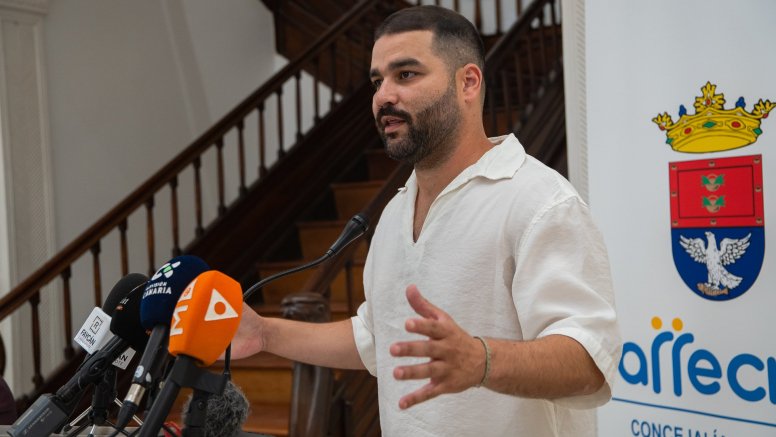
"I say no, and because I say no, we are at a standstill. We will not proceed until they fulfill what we want," stated emphatically the Minister of Territorial Policy and Land Management of the Cabildo of Lanzarote, Jesús Machín Tavío (Coalición Canaria), during his appearance on *Radio Lanzarote-Onda Cero* this past Tuesday. "They have produced some maps that were not ideal," highlighted Machín, who argued that for a "multinational, 15 hectares of rural land is more appealing, and that's it," and therefore "we shouldn't make it easy for them."
The Lanzarote native insisted that the island institution will not give in to the demands of its governing partner in the Canary Islands Executive: the Popular Party. For the moment, both political parties maintain two opposing positions. Ecological Transition is not budging and insists that renewables will occupy 3.75% of Lanzarote, while the Cabildo proposes 0.25%.
Only two months passed since the Ministry of Ecological Transition of the Canary Islands Government and the Cabildo of Lanzarote announced that the Biosphere Reserve island was the first in the archipelago to determine the Renewable Acceleration Zones, until the island institution demanded that the Canarian Executive rectify the published maps and backtrack on their approval.
Since then, the Canary Islands' counselor for Ecological Transition, Mariano H. Zapata (People's Party), and the head of Territorial Policy and Land Management of the Cabildo of Lanzarote, Jesús Machín Tavío (Canarian Coalition), have made conflicting statements and do not seem to find common ground
First the built-up areas and anthropized zones
"The law says that first you have to occupy all the decks, when we occupy the decks we go to the ground and after going to the ground we will decide the percentage we want," maintains Machín, who announced on the morning show *Buenos días, Lanzarote* that the president of the Cabildo of Lanzarote, Oswaldo Betancort (CC), is going to send a resolution to the Government of the Canary Islands announcing the institution's strong opposition to the published maps."I am more radical than anyone and **no one knows our territory better than we do** and [...] knows what we want for the future," continues Jesús Machín, who assures that he has Betancort's support in his stance. "We want **public penetration** and when public is no longer sufficient, then private," maintains the councilor, who wants to prevent the images of renewables occupying Fuerteventura's land from being repeated in Lanzarote."If there is opposition, the President of the Canary Islands government has told me that nothing will be done against the island councils," assures Machín, who advocates for first implementing renewables on anthropized land and then regulating the rest.
A dispute a few months after announcing the measure
In the middle of summer, the president of the Cabildo of Lanzarote, Oswaldo Betancort (Coalición Canaria), and the counselor of the Government of the Canary Islands, Hernández Zapata, announced that both institutions had reached a consensual and sustainable agreement for the installation of renewables on the island. At the end of August, Transición published in the Official Gazette of the Canary Islands the maps that determined that renewables would occupy 3.75% of the island's territory.
In September, the Cabildo of Lanzarote requested the rectification of the maps that allowed for the creation of solar panel fields in Lanzarote, asserting that the document that was finally published did not correspond to what had been agreed upon. "We are not in favor of alternative energy everywhere, and we have done exhaustive work to reduce everything that the Government of the Canary Islands intended," Machín defended at the time.
Despite the firm stance of the island's main institution, the Minister of Ecological Transition of the Canary Islands Government, Mariano H. Zapata, has repeatedly downplayed the **gravity of the published maps**, pointing out that they were "four material errors in four plans" and that they were "solely graphical, not surface" errors
At the end of December, in the last commission of the year on Ecological Transition and Energy of Parliament, it insisted that the surface data "were and remain correct" and that the forecast is that renewables will occupy 3.75% of Lanzarote.
Add La Voz de Lanzarote as a preferred Google source.
Stay informed with the latest current news.