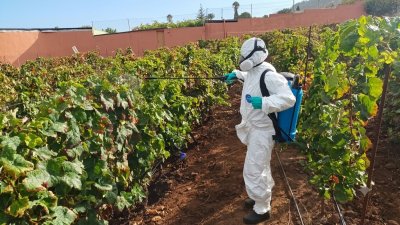
The Ministry of Agriculture, Livestock, Fisheries and Food Sovereignty of the Government of the Canary Islands has completed this week the 2026 vine phylloxera prospecting campaign with the carrying out of a total of 4,435 inspections, distributed in 3,536 aerial part reviews and 899 soil samples throughout the Archipelago, which represents an increase of 21% and 27% respectively compared to the initial forecasts.
In this regard, the minister of the area, Narvay Quintero, recalled that the surveillance work has resulted in the detection of four new positive cases between April and May in abandoned farms located in the so-called "ground zero," which encompasses the area of the Protected Designation of Origin Tacoronte-Acentejo. "These results reflect the effectiveness of the work carried out by the regional Executive in collaboration with the Regulatory Councils of the Protected Designations of Origin of Canary Wines and the island councils, which has prevented the pest from spreading to other areas."
The head of the department emphasized that, as a result of these findings, the Ministry has approved a modification of the Order of August 20, 2025, which declares the fight against vine phylloxera in the Canary Islands to be of public utility and establishes the phytosanitary measures for its control and eradication, with the aim of adapting the action strategy to the evolution of the pest, which involves making some phytosanitary measures more flexible while strengthening surveillance in the "demarcated zone."
With these changes, the demarcated zone around the detected outbreaks is also redefined, establishing an infested zone of 50 meters around each positive case compared to the 500 established until now, a zone of special surveillance up to 500 meters, and a buffer zone of two kilometers. Likewise, follow-up actions within these areas are intensified through a reinforced program of prospecting, visual inspections, and sampling, while new eradication and prevention measures are incorporated, such as specific phytosanitary treatments, the elimination of infested plants, and hygiene protocols for agricultural work and grape transport.
Likewise, the resolution flexibilizes restrictions on the movement of fresh grapes and plant material in those territories free of the pest and allows their circulation between unaffected islands and within Tenerife outside the demarcated zone, while maintaining limitations in areas where the risk of dispersion persists. "In this way, the measures are adjusted to the current phytosanitary situation and we can concentrate control efforts around the outbreak, which will allow the next harvest to proceed normally in the rest of the Archipelago," stressed the counselor.
As Quintero has pointed out, "in the Canary Islands, we are in the eradication phase," which could make the Archipelago, if this process is successfully completed, the first European region to eradicate this pest, since in the rest of the territory, although contained, it has not been completely eradicated." He also indicated that the end of the campaign does not mean the cessation of surveillance work, as the Ministry will continue to carry out monitoring actions throughout the Archipelago and will intensify prospecting in the demarcated area of Tenerife, where reinforced surveillance will be maintained through visual inspections, soil and root sampling, laboratory analysis, and other detection techniques.
"This reinforced surveillance will allow us to continue analyzing the evolution of the phytosanitary situation, verify the effectiveness of the measures adopted, and prevent the possible dispersion of phylloxera to new wine-growing areas of the Islands," he added, while thanking the collaboration provided by winegrowers, wineries, regulatory councils, island councils, and the entire Canarian wine sector, "whose involvement continues to be fundamental to protect one of the most unique agricultural heritages of the Canary Islands and preserve the genetic and productive richness of its vineyards."
Of the surveys carried out this year, 1,902 inspections have been carried out in Tenerife, which remains the only island with the presence of phylloxera. In Lanzarote, 1,373 have been carried out; in La Palma, 656; in El Hierro, 148; in Gran Canaria, 147; in La Gomera, 132; and in Fuerteventura, 77. With these works, a total of 12,361 surveys have been carried out to date, of which 7,926 correspond to those carried out last year.
These actions have been developed in accordance with the provisions of the Daktulosphaira vitifoliae Contingency Plan of the Ministry of Agriculture, Fisheries and Food (MAPA), following the general guidelines of the European Food Safety Authority (EFSA) for plant pest surveys. The sampling program has been designed using a statistically sound and risk-based methodology, applying the RiPEST tool, which allows for the determination of the size of the surveys and optimization of the pest detection capacity.
On the other hand, the fieldwork has been carried out through a commission from the Directorate General of Agriculture to the public company Gestión del Medio Rural de Canarias (GMR Canarias), an entity that has carried out the inspection, sampling, and phytosanitary monitoring tasks planned for the year on the ground.
Surveillance actions have been carried out both in producing vineyards and in abandoned vineyard plots distributed throughout the Archipelago. The latter have been the subject of special attention, since the outbreaks detected to date are mostly located in this type of area, considered priorities within the risk-based surveillance strategy established in the Contingency Plan.
"Canary Islands thus maintains a permanent phytosanitary surveillance system against phylloxera, based on scientific criteria, risk analysis, and early detection, as an essential tool for the protection of the wine sector and the conservation of the Canary Islands vineyard," concluded the regional minister.
Add La Voz de Lanzarote as a preferred Google source.
Stay informed with the latest current news.