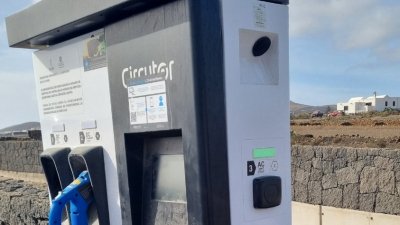
The Cabildo of Lanzarote has already put into operation the new fast charging point for electric vehicles in Playa Blanca, after completing the work of replacing the previous equipment, which was obsolete.
The new installation, located in front of the bus station in the southern town, seeks to "improve the capacity of the service and its operability, thanks to the incorporation of the latest generation technology".
This action has been executed by the Energy Area, directed by the councilor Miguel Ángel Jiménez, and is part of the island's strategy to promote the decarbonization of land transport. The intervention has been co-financed through the Canary Islands Development Fund (FDCAN), managed by the Area of Planning and Coordination of Projects, Finance and Contracting of the Cabildo, directed by María Jesús Tovar.
“The entry into service of this new charging point represents an important step forward in our commitment to sustainable mobility and the reduction of polluting emissions,” said Jiménez. “We are taking firm steps towards an island charging network that allows electric vehicle users to travel with guarantees throughout the island territory,” he added.
The Minister of Energy also recalled that this new point has similar features to those already operating in the Monumento al Campesino and in Arrieta, which they defend "guarantees a homogeneous and reliable network at the service of the citizens".
For her part, the head of the Area of Planning and Coordination of Projects and insular vice-counselor, María Jesús Tovar, stressed that "this action is a sample of the coordinated and rigorous work that we are carrying out from the management of the FDCAN, where each investment responds to a strategic planning oriented to collective welfare, sustainability and balanced development of the territory".
The contract, awarded to the company IMESAPI S.A., contemplated both the supply of the new equipment and its installation, for a total amount of 38,283.28 euros. Currently, the Cabildo of Lanzarote has other actions underway in Costa Teguise, Tinajo, Playa Honda, Tías, and projects planned in Arrecife, Órzola and Yaiza, all of them also co-financed by the FDCAN.
Add La Voz de Lanzarote as a preferred Google source.
Stay informed with the latest current news.