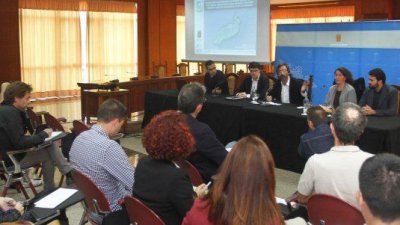
This Thursday, the study on renewables "Lanzarote RB: Future Electrical System 2013. 2020. 2038" was presented at the Cabildo. Modeling carried out by the company 3iDS. The Energy Transition in Lanzarote until 2038 was presented with data and criteria of the possible future scenarios calculated. The expert who collaborates with the Water Consortium in defining the change of Energy Model, Jorge Morales de Labra; assures that "with the current technology, we can go from the current 4% of renewables in electricity, to 75% without increasing costs in the electricity bill," if the necessary infrastructures are created.
"For this it is necessary to invest 600 million euros, so that in 2038 57 wind turbines, 40,000 electric vehicles and several photovoltaic plants are operating, among other facilities," he says. The study "shows that these investments are profitable and points out that 60% of them could be carried out by private companies. This possibility is based on the fact that the current law states that any installation of this nature has between 6.5 and 7.5% profitability."
This study is carried out by the Water Consortium and the Biosphere Reserve Council so that, based on rigorous and real data, a future model based on alternative energies can be made. The president of the Cabildo de Lanzarote and of the Water Consortium, Pedro San Ginés; assured that to reach this objective a "decisive, consensual and public commitment is needed. Therefore, in the second half of January the document will be made public and will be transferred to the Council of the Biosphere Reserve, an entity that plans to schedule an agenda to present it in other social forums."
The Councilor for Energy of the Corporation, Ariagona González, stated that "the Cabildo has been working for some time on this change of energy model, both creating a network of charging points for electric vehicles; aid to self-consumption; or creating the single window for renewable energies; as well as requesting a regulation that allows the increase and accumulation in batteries of alternative energies."
The work presented by the engineer José Martín Hernández states that "in the energy model in 2013 there is a high fuel consumption of 248,260 tons of oil equivalent per year, with an approximate cost of 170 million euros; and 850,700 tons per year of high emissions of gases produced by humans GHG (Greenhouse Gas). Among the real data and those of the simulation to carry out the study there is only a margin of error of 3%, a fact that validates and guarantees the rigor of the work."
In the simulation planned for 2020: the Los Valles Wind Farm operates with the ten wind turbines; there are the two wind turbines of Punta Grande; the Punta de Los Vientos Wind Farm is completed with six new wind turbines; and the Teguise wind farm is also completed with four new wind turbines. Likewise, the Solar Photovoltaic Park, Balsa de Maneje, begins to generate clean energy. With these infrastructures, the Island will be consuming 20% of renewable energy.
In 2038 the figure would increase to 57 wind turbines distributed in twelve large parks in Lanzarote; the number of electric vehicles would amount to 40,000, and there are several photovoltaic plants. All this would allow a penetration of renewables that would amount to 57.7%, as well as a 40% reduction in CO2 emissions. In addition, this figure, if batteries were put into operation to accumulate energy, could mean that the Island would reach 75% of electrical energy consumed from renewables.
Therefore, the study concludes that "all this would allow the Island to obtain an autonomy of 50% of energy dependence in 2038."

Add La Voz de Lanzarote as a preferred Google source.
Stay informed with the latest current news.