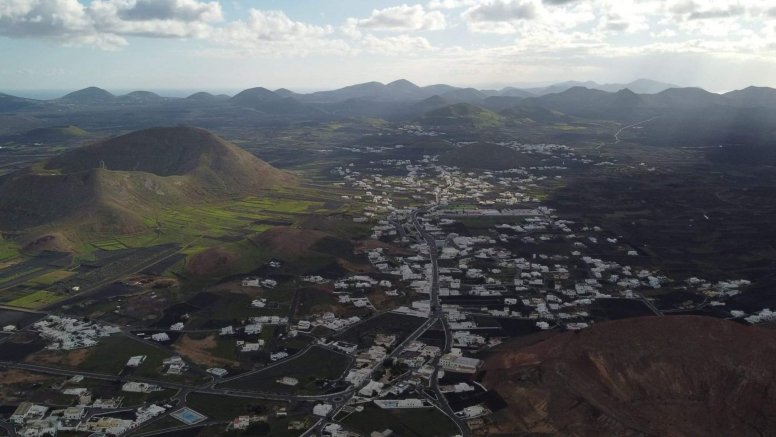
The Lanzarote Island Council will ask the Ministry of Ecological Transition of the Canary Islands Government to rectify the maps to create solar panel fields on the island. In the case of Lanzarote, these renewable fields would occupy more than 3,100 hectares, which is almost 4% of the island's territory.
Despite the fact that the Minister of Ecological Transition and Energy, Mariano Zapata (PP), and the president of the Lanzarote Island Council, Oswaldo Betancort (CC), had agreed on which spaces on the island can host this type of energy installations and which could do so if certain conditions are met, the Island Council does not agree with the text published on this issue.
"The Canarian Government has erred in the publication of the maps and has established the first ones that were proposed when in reality they are the last ones that we have agreed upon and with which we agree." Due to this, the Lanzarote Island Council will start the procedure again and it will be the Canary Islands that will have to publish the protocol together with the maps.
For its part, from Ecological Transition they point out that "only one of them needs to be corrected."
According to Jesús Machín, Minister of Territorial Policy of the Lanzarote Island Council, "we are not in favor of alternative energy everywhere and we have done an exhaustive job of reducing everything that the Canary Islands Government intended." In this sense, Machín assures that "they have corrected the document more than seven times and what they intended at the beginning for Lanzarote has been reduced."
In addition, the Minister of Ecological Transition has made it clear that this project "has an environmental project and that it has a public information process where citizens and institutions will be able to establish what they deem appropriate."
Areas suitable for renewables
The project has defined two types of areas: one where the installation of renewables is suitable and another where it is conditional. These last ones must first review incompatibilities in aspects of Agriculture, Biodiversity or aeronautical easements, among others, in order to become suitable.
Sources from the Ministry of Ecological Transition of the Canary Islands Government and the Lanzarote Island Council have confirmed to La Voz that these projects would be developed on the ground and not on roofs or rooftops. In this way, the Executives led by the Canarian Coalition and the Popular Party clash with the criteria of the PSOE of Lanzarote, which advocates for exhausting the rooftops of already built spaces so as not to consume more territory.
According to Ecological Transition, the areas exclude spaces included within the Natura 2000 Network, Sites of Community Interest, protected natural spaces and take into account incompatibility criteria with municipal and sectorial planning. However, they do contemplate their installation on rustic land, on non-cultivable surfaces and that do not present other incompatibilities with the law.
The idea of these Renewable Energy Acceleration Zones (ZAR) is to "facilitate promoters" the identification of suitable locations and speed up their installation, according to the aforementioned resolution.
These proposed areas must go through an administrative procedure that determines the final delimitation and present an environmental assessment.
Rejection from Tías
The municipality of Tías is one of the most coveted for the installation of green energies. The City Council, led by the PSOE and Unidas Podemos, has already opposed on two occasions the installation of photovoltaic panels promoted by private companies in Mácher. One of them proposed installing 7,000 panels and a second, another 1,680.
In the case of Tías, the resolution contemplates large mixed areas, where solar and wind energy will converge. In this sense, it contemplates land occupations in the surroundings of Puerto del Carmen and Puerto Calero. To this, are added plots in the towns of Mácher, La Asomada and Conil.
"The town councils will have to say something and we are not going to allow them to sow all the rustic land, in the surroundings of the Mácher substation, with solar panels", expressed José Juan Cruz, mayor of the municipality, annoyed. Tías has announced that they will put in the hands of the municipal legal services to appeal this agreement.
Add La Voz de Lanzarote as a preferred Google source.
Stay informed with the latest current news.