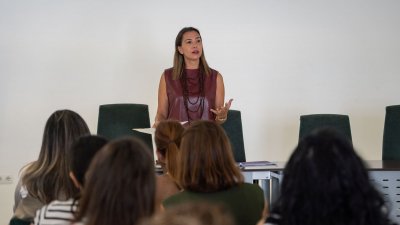
The Department of Social Welfare, Equality and Immigration of the Arrecife City Council, led by Maite Corujo, will hold next Wednesday March 4 the round table “Journalism, veracity and equality”, an initiative framed within the program on the occasion of the Día Internacional de las Mujeres.
The meeting will take place from 17:00 to 20:00 hours at the Casa de la Cultura Agustín de la Hoz and will be open to all citizens. The activity will bring together different Canarian journalists to reflect on the role of journalism committed to human rights in the face of disinformation, hate speech, and sexist violence.
Councilwoman Maite Corujo has stressed that “in a context where disinformation and hoaxes circulate with enormous speed, it is fundamental to reclaim rigorous journalism, with a gender perspective and committed to equality.” In this regard, she adds that “the media play a key role in the construction of referents and narratives; therefore, from public institutions we must generate spaces for reflection that reinforce the commitment to truthfulness and human rights.”
Corujo also highlights that this round table “not only seeks to analyze the current challenges of journalistic practice, but also to recognize the work of professionals who, from the Canary Islands, are contributing to a more just, responsible, and transformative communication.”
The debate will address the need to incorporate the gender perspective in newsrooms, contextualize sexist violence as an expression of structural inequality and avoid approaches that reproduce stereotypes or blame the victims. Likewise, emphasis will be placed on the importance of prioritizing rigor over the easy click, promoting narratives that place equality and social justice at the center.
Journalism with a gender perspective
The round table will feature the participation of:
- Ngone Ndiaye, collaborating journalist of the Pulitzer Center, with a background in communication linked to human rights and social justice, standing out for her international perspective and her commitment to migratory realities and cultural diversity.
- Natalia G. Vargas, journalist at Canarias Ahora, specialized in social and political information, with experience in the analysis of inequalities and in the coverage of topics related to rights and citizenship.
- Nerea López Cabral, journalist for Diario de Fuerteventura, where she develops an informative work focused on island news and social issues, incorporating a critical and contextualized perspective into her reports.
- Andrea Domínguez, journalist at La Voz de Lanzarote, with experience in local press and coverage of social issues, standing out for her attention to the reality of Lanzarote and to the problems affecting the citizenry.
The panel will be moderated by Nadia Martín García (Las Palmas, 1995), journalist and photographer specializing in Gender Studies, recognized with the Premio Meninas 2025 for her commitment to equality and the eradication of sexist violence.
Training workshops on disinformation prevention
The round table “Journalism, veracity and equality” is part of a broader project aimed at preventing disinformation and promoting equality and social justice.
Under the title “The prevention of disinformation as an instrument for equality and social justice,” this initiative proposes an educational and awareness-raising strategy especially aimed at the young population of the municipality. The program combines public reflection spaces —such as the round table organized on the occasion of 8M— with training workshops in educational centers in Arrecife aimed at 4th year ESO students.
These workshops, with an approximate duration of one and a half hours, will offer students tools to identify hoaxes, cross-reference sources and understand the impact of disinformation on democratic coexistence and on gender equality, through a participatory methodology that combines theoretical content and practical dynamics.
The project has as its general objective to foster critical thinking and provide information verification tools, while contributing to prevent hate speech and the violence derived from these. Among its specific objectives are to enhance critical capacity regarding information circulating on the internet, promote practices of coexistence and good treatment from early ages, and foster equality through training and awareness-raising actions.
In addition to the in-person activities, the project contemplates the elaboration of didactic materials and educational resources that will allow to reinforce the contents worked on during the training sessions and facilitate their dissemination among the educational community.

Add La Voz de Lanzarote as a preferred Google source.
Stay informed with the latest current news.