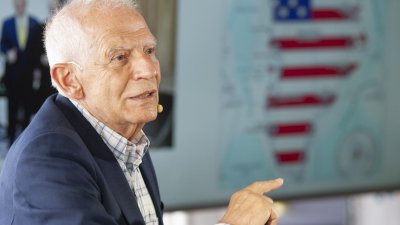
The former Vice-President of the European Commission Josep Borrell spoke this Friday morning at the Castillo de San José in Arrecife, the capital of Lanzarote, in a new edition of the Dialogues of the South Global Forum.
During his speech at the Forum, the also former high Representative of the European Union for Foreign Affairs and Security Policy, he unraveled for just over an hour the main intricacies of the international political chessboard.
"There are three characters who are building today's world: Xi [Jinping], Putin, and Donald Trump. There is no European among the architects of tomorrow's world," highlighted the former socialist minister during the governments of Felipe González and in the first term of Pedro Sánchez. "And none of the three is a friend of Europe," he added.
China, a key country on the international chessboard
In a conversation led by journalist Alberto Acosta, Borrell summarized the European Union's relationship with China in three concepts: "A partner, a competitor, and a rival." The former European leader insisted that Europe must deal with the Asian giant "like it or not," but knowing that it is "a threat to our productive sector," especially the automotive sector.
From his perspective, the European Union cannot follow in the footsteps of the United States, as the North American country fights for "world hegemony" and its position varies depending on who occupies the White House.
"We cannot see China as someone to beat or fight against because there is no problem in humanity that can be resolved without great collaboration from China," highlighted the former Vice-President of the European Commission.
Europe under the military protection of the United States
During his speech, Borrell echoed two famous photographs that have gone around the world. In the first of them, during a G7 summit in 2018, the former German Chancellor Angela Merkel can be seen leading a meeting of international leaders, in which US President Donald Trump remains seated in a defensive position. Facing the other, from 2025, in which several European leaders sat in front of him, reversing the positions of power.
The socialist has described these images as "a Europe that still stands up and another Europe that comes submissively." The former high representative of the European Union has pointed out that in the confrontation with Trump "it is clear who has won." Thus, he has highlighted that "in some way," Europe is "an American military protectorate," with soldiers stationed in its bases, selling missiles to Ukraine or military information from its satellites.
Faced with the increase in armed conflicts on Europe's doorstep, Josep Borrell has pointed out that "Europeans believe that peace is the natural state of things." "We have no warlike ardor and that is great news," the former minister has emphasized, who assures that if Europe's neighbors do not understand it the same way, the continent is left in "a position of structural weakness."
Europe has been losing military capacity over the last 25 years. "We have secularly disarmed ourselves," Borrell has insisted, who explains that the question the continent must ask itself is whether it really wants to have that own military capacity to be able to defend itself.
At the same time, he regrets that this rearmament is being carried out in a differentiated way between countries. "The European army remains a beautiful idea that has no practical realization," he has added.
Latin America and Africa, potential partners?
Regarding Latin America, Borrell has maintained that it "does not exist" because it is not a real geopolitical unit due to the scarce political, physical, and commercial integration of the different countries that make it up, characterizing it instead as "the most violent and unequal region in the world." Thus, he has highlighted that the great bond that unites Spain with this continent is mainly of a "brotherly" nature, while in the purely commercial and business sphere, China has consolidated itself as the true strategic partner.
In Latin America, for example, the Asian giant controls the refining and the market for minerals, such as lithium, which are abundant in Latin American soil and are fundamental for the global technological transition.
Regarding Africa, Borrell has indicated that Europe's relationship with this continent is profoundly marked by the colonial past and also by more recent grievances, such as the inequality in vaccine distribution during the COVID-19 crisis. "Facing life and death, inequality is most dramatic," he recalled that during the pandemic, Europeans vaccinated their inhabitants with two doses, and in the neighboring continent, only 20% of the vaccines had been distributed.
The former Spanish and European leader explained that, unlike Europeans, who tend to condition their aid through internal reforms, China intervenes more visibly, financing large infrastructures in exchange for resources. Meanwhile, Europe bears the invisible cost of military missions to maintain peace in various territories, an effort that does not translate into political influence, leaving the Union's countries in a lagging position.
European hypocrisy with Palestine
Regarding the genocide of the Palestinian people in the Gaza Strip, Josep Borrell has criticized the stance of some European countries. Borrell has pointed out an unprecedented fact, which is that "Germany did not get enough votes in the Council in the United Nations General Assembly to have a seat on the Security Council" due to its lukewarmness in denouncing the genocide.
"They have figured us out and say: 'No, you are a bunch of hypocrites, you cry a lot for the fate of Ukraine, but you don't shed a tear for the Palestinians'," he stated.
Democracy: "We would all prefer to live in Europe"
"Democracy cannot be the ritual of choosing a president every so often who will be removed the day after tomorrow by a coup d'état or whatever," he stated. Borrell argued that in Spain we should be "satisfied" to have been living in a democratic regime since 1975.
"There are many parts of the world, particularly in countries with a colonial heritage or that have suffered the blows of imperialism, where democracy is not perceived," he added.
To conclude, Borrell stated that "we would all prefer to live in Europe, not in the United States, not in China, nor in Russia, because we are the best combination of freedom, prosperity, and cohesion."



Add La Voz de Lanzarote as a preferred Google source.
Stay informed with the latest current news.