Four educational centers in Lanzarote are part of the 37 schools and institutes that are part of the IDAFE project, an initiative of the Government of the Canary Islands to reinforce climate adaptation in the educational field. These are the centers CEO Montaña Roja, IES Altavista, Playa Honda, and Tías.
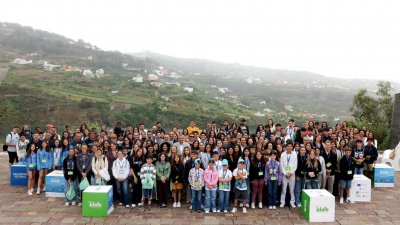
The Ministry of Ecological Transition and Energy of the Government of the Canary Islands, led by Mariano Hernández Zapata, and the Ministry of Education, Vocational Training, Physical Activity and Sports, headed by Poli Suárez, celebrated this Wednesday the II Regional Meeting of the IDAFE Project, which took place in Moya (Gran Canaria), and was attended by the vice-president of the Canary Islands, Manuel Domínguez, where nearly 130 students and more than 50 teachers from 29 of the 37 participating centers shared the work and proposals developed during the course.
During the event, which was also attended by the mayor of Moya, Raúl Afonso, and the vice-minister of Ecological Transition, Fight against Climate Change and Energy, Julieta Schallenberg, the students presented through videos and explanatory posters the actions promoted in their educational centers to analyze and improve their adaptation capacity to the effects of climate change.
The meeting also served as a space for exchange of experiences, joint learning, and highlighting the commitment of the Canarian educational community to climate action.
Scientific rigor and technical support
One of the keys to the project is the combination of scientific rigor, technical support, and practical application in the classroom. In its first edition, corresponding to the 2024-2025 academic year, IDAFE had the participation of 29 educational centers, 2,525 students, 108 class groups, and 150 teachers. On that basis, the initiative has expanded its reach during the current academic year to reach 37 educational centers, with the participation of 2,695 students, 147 groups, and 132 teachers.
The Vice President of the Government of the Canary Islands, Manuel Domínguez, highlighted that initiatives like the IDAFE Project demonstrate that the best tool to face the challenges of climate change remains education. In this regard, he underlined the commitment of the more than 2,600 students and more than 130 teachers who have participated in this edition, and stated that “The Canary Islands need committed, trained young people who are aware of the challenges ahead of us to build more sustainable, more prepared, and more resilient islands”.
The Minister of Ecological Transition and Energy, Mariano Hernández Zapata, highlighted that “IDAFE is an example of how climate action can be effectively translated into people's daily lives through education”. In this regard, he pointed out that “the project allows young people to better understand the challenges posed by climate change in the Canary Islands, analyze the reality of their own schools, and actively participate in the search for solutions that contribute to building a more resilient and prepared society”.
Likewise, he stated that “adaptation to climate change requires knowledge, involvement, and co-responsibility, and that is precisely what IDAFE achieves: connecting scientific rigor with the active participation of students to generate a solid climate culture from an early age”.
For his part, Poli Suárez highlighted that “climate change is already a reality that affects our daily lives and, of course, educational centers as well”. Therefore, he explained that “the response must be given in two complementary areas: training the generations who will have to face these challenges in the future and adapting our centers to this new reality from today”. In this regard, he pointed out that “projects like IDAFE allow students to better understand the climate challenges of the Canary Islands and actively participate in the search for solutions”.
Furthermore, he recalled that the Ministry promotes various actions to move towards schools better prepared for the effects of climate change. Among them, he highlighted the Project for the Naturalization of Educational Spaces, an initiative aimed at progressively transforming patios and outdoor spaces through the incorporation of vegetation, natural elements, and comfort zones, turning these environments into active learning spaces. “We want our schools to also be an example of adaptation to this new reality, while improving the habitability conditions of school spaces,” he added.
In the same vein, the mayor of the Villa de Moya, Raúl Afonso, emphasized the importance of bringing environmental education closer to new generations and highlighted the role of educational centers as agents of change. “It is a source of pride for the Villa de Moya to host this regional meeting that brings together students and teachers from all the islands around a challenge as important as adapting to climate change. Initiatives like IDAFE demonstrate that education is a fundamental tool for building a more conscious, prepared, and committed society for the future of our territory,” he pointed out.
Raúl Afonso highlighted that “young people are not only the protagonists of tomorrow, but also of today. Their involvement, their ideas, and their ability to provide innovative solutions are essential to face the environmental challenges ahead. From the administrations, we must continue to support learning and participation spaces like this, which foster collective responsibility and the care of our environment.”
The Idafe Project, in detail
Throughout last April, the project developed monitoring and support visits in the 37 participating educational centers throughout the Canary Islands, strengthening its implementation in classrooms and joint work with teachers and students on climate adaptation. These sessions allowed for direct tutoring of the project's implementation at different educational levels, from 5th and 6th grade of Primary Education to 4th grade of ESO.
During these visits, specific support was offered to resolve doubts about the learning situations developed within the project framework, guidance on the use of environmental measurement instruments, and advice on the development of the School Strategy for High Temperature Episodes (EsAE) that each center must design. This work has been complemented by continuous support through videoconference tutorials and permanent attention to the queries raised by the educational community.
IDAFE has consolidated itself as an initiative capable of incorporating climate action into the Canarian educational system, adapting to the official curriculum and fostering an effective alliance between the Ministry of Ecological Transition and Energy, the Ministry of Education, Vocational Training, Physical Activity and Sports, and the educational centers themselves, which become key players in the process. The project is developed collaboratively between both areas of the Government and is integrated within the framework of the Canarias-InnovAS Network, connecting scientific knowledge about climate change with daily educational practice.
The initiative also possesses significant strategic value by being part of the measures planned in both the Canarian climate change regulations and the Canarian Climate Action Strategy to promote education, training, and awareness in climate mitigation, adaptation, and governance.
The IDAFE project is financed from the General Budgets of the Autonomous Community of the Canary Islands and is eligible for co-financing of 85% by the European Union through the Canarias FEDER 2021-2027 Programme, within the priority linked to the green transition, adaptation to climate change, and resilience. This European funding supports a line of work that places education and social involvement as fundamental elements for building a more prepared Canary Islands for present and future climate challenges.
In this edition, 37 educational centers from the islands have participated. In Gran Canaria, CEIP Jaime Balmes and IES Arencibia Gil, Villa de Firgas, Carrizal, Simón Pérez, José Zerpa, Faro de Maspalomas, Jinámar, Cairasco de Figueroa, Las Huesas, Ana Luisa Benítez and Arguineguín-Lidia Pulido; in Tenerife, IES Las Galletas, Los Cardones, Profesor Martín Miranda, Canarias, Marina Cebrián, Alcalde Bernabé Rodríguez, Montaña de Guaza, Los Cristianos, San Andrés, Tomás de Iriarte, Luis Diego Cuscoy, Güímar and Viera y Clavijo; in Lanzarote, CEO Montaña Roja and IES En Altavista, Playa Honda and Tías; in La Palma, IES Puntagorda, Alonso Pérez Díaz and Luis Cobiella Cuevas; in La Gomera, CEO Vallehermoso and Santiago Apóstol; in El Hierro, CEIP Valverde and CEIP Taibique; and in Fuerteventura, IES Vigán.


Add La Voz de Lanzarote as a preferred Google source.
Stay informed with the latest current news.