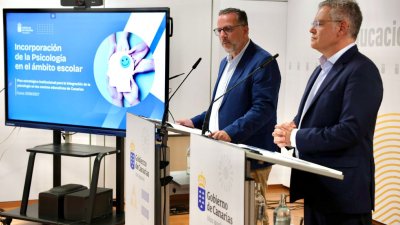
The Ministry of Education, Vocational Training, Physical Activity and Sports, led by Poli Suárez, will increase to eighty the number of psychologists who will attend to the archipelago's students next school year within the framework of the Strategic Plan for the incorporation of Psychology in the school environment of the Canary Islands, a figure that doubles the 39 workers announced last April and will also mean doubling the initially planned budget, which will go from 2.17 to 4.46 million euros.
Of these professionals, 72 will be distributed among the 36 Educational and Psychopedagogical Guidance Teams (EOEP) of the islands, at a rate of two for each of them, while the remaining eight will be distributed among those EOEPs whose affiliated centers have registered a higher number of activations of the Protocol for Intervention in case of suicidal risk (PIRS) in recent times.
"This is an important commitment by this Ministry to improve the evaluation and prevention of psychological disorders and problems that affect the well-being of our students," according to Poli Suárez, for whom the measure "ratifies the commitment" of her department to "the care of the educational community in the field of mental health."
In this regard, this Thursday, the Vice-Minister of Education, José Manuel Cabrera, and the Directors General of Personnel and Teacher Training and of Educational Planning, Inclusion and Innovation, Mónica Ramírez and David Pablos, respectively, have presented to the union representatives the draft of the instructions that will regulate, so that they do not interfere with those of other agents, the functions of these professionals, as well as the organization and functioning of the new staff, which will be published soon, once the contributions from the groups being consulted, including the two Professional Colleges of Psychology of the islands, have been received.
Functions and priorities
The new educational psychologists will act in the area of promoting mental health and emotional well-being of students, and will advise teachers and families, in coherence with the strategic lines of well-being and coexistence of the Canarian educational system.
In addition, and without prejudice to actions that may be developed in other age groups when circumstances so advise, their intervention will be primarily directed at students between twelve and eighteen years of age. Likewise, priority will be given to students with suicidal behavior, including self-harm, suicidal gestures, or suicide attempts; to students involved in cases of school bullying or cyberbullying, and to those affected by gender violence or immersed in gender identity processes (trans).
Also preferably, they will act in secondary education institutes (IES), integrated vocational training centers (CIFP), special education centers (CEE), and compulsory education centers (CEO) supported by public funds, being able to intervene in other centers, particularly in early childhood and primary education centers (CEIP), when necessary.
According to the draft instructions establishing the functions and determining the organization and operation of educational psychology personnel, prepared by the General Directorate of Educational Planning, Inclusion, and Innovation, these professionals will intervene at the request of the aforementioned centers, prioritizing cases for reasons of urgency, severity, or ineffectiveness of previously adopted measures. Likewise, and in addition to these requested interventions, they will develop a work plan aimed at prevention, training, and coordination tasks among students, teachers, and families.
Thus, they will promote actions among students related to their psychological and emotional well-being, in collaboration with Guidance personnel; they will offer reception and listening spaces to address situations of emotional distress and will follow up on attended cases, collaborating in the psychological assessment of students and in referrals to Mental Health units, in cases of special complexity or that require specialized support.
In addition, they will collaborate in the application of the individual phase of the PIRS, accompany and guide centers in the follow-up and actions derived from its activation; they will carry out emotional support actions in situations of bullying or cyberbullying and in the application of protocols related to gender violence, trans students, and attention to gender diversity. Finally, they will coordinate with health services for the therapeutic care of students and will keep a record of the actions carried out.
With the teaching staff, psychologists will offer support, advice, or specialized training related to mental health and emotional well-being, they will collaborate in the implementation of student emotional well-being programs, especially in educational centers with a high number of students in vulnerable situations, and they will accompany, inform, and advise tutors and teaching teams.
Finally, with families, they will collaborate in training, promotion, and prevention activities, related to healthy habits, mental health, or emotional education, among others; they will offer guidance on accompanying their children, in matters of mental health and emotional well-being, and will provide psychological support and coordination with external services, as well as accompaniment and listening in processes related to minors, facilitating communication and coordination with the educational center and with external services, if necessary.
The actions of these professionals will be complementary to those of other agents, not supplanting the functions of other profiles in any case, and, in particular, those of the Orientation staff. In this sense, emotional accompaniment and psychological support actions will be occasional and justified, and cannot be interpreted as a therapeutic intervention service, according to future instructions, which include the general principles of professional intervention (preventive, educational, guidance, specialized, and psychological support in the school environment, always from a socio-educational and inclusive perspective, without replacing the clinical, diagnostic, or specialized therapeutic care of the health system and respecting the principles of confidentiality, minimal intervention, protection of the best interests of the minor, prevention, inclusion, interprofessional coordination, and personal data protection, among others).
The new instructions also contemplate the organization of new staff and necessary coordination, as well as the characteristics of the annual plan and the final report that these professionals must carry out and the procedure that centers must follow to request their intervention and which has been presented to the unions.
Procedure
In addition to the activities planned in its work plan, psychological staff will attend, through the channels established at the beginning of the school year, requests for intervention, individual or group, requested by the management (or person to whom they delegate) or by the Guidance departments of the centers, after coordination with the former.
For an adequate assessment of the priority of intervention, and in the event of possible simultaneous requests, the requests must be duly motivated and justified, providing the necessary information about the situation that gives rise to them, background information, and previous measures adopted (if any).
In the case of underage students, requests for individual intervention must have the express authorization of at least one parent or legal guardian, and the actions taken must be recorded in the student's file, in accordance with the models that will be provided at the beginning of the school year by the General Directorate of Educational Planning, Inclusion and Innovation, guaranteeing the custody, confidentiality, and restricted access to information, in application of data protection regulations.
Finally, the advice of the Coexistence and Well-being area of the aforementioned General Directorate will be sought, as well as the technical opinion of the coordinator of the EOEP and the coordinating Inspector of said team.
Strategic Plan
It should be recalled that last April, the counselor, Poli Suárez, already presented the strategic plan for the incorporation of Psychology in the school environment of the Canary Islands, an initiative that, he announced, would begin to be deployed in the next academic year with the aim of reinforcing attention to the emotional well-being of students and improving the educational system's response to new mental health challenges.
The model, which is now improved with the increase in both staff and budget, represented a structural advance in educational care, by integrating general health psychology professionals within the public educational centers of the islands.
“This plan responds to a reality that is already present in our classrooms and that demands a response from us,” explained Poli Suárez at the time, who stressed that “mental health is a key element for the coexistence and development of our students and requires our effort to improve it”.
This initiative will allow us to "act earlier and better but, above all, in a more coordinated way, incorporating specialized profiles that support the work already being done within the educational system," added the counselor, in a context in which, "since the beginning of the school year, nearly six hundred interventions with students at high or imminent risk of mental health problems have been recorded."
Likewise, he pointed out that "we are arriving at a time when educational centers are facing increasingly complex situations related to the emotional well-being of students, and we must be able to anticipate them with adequate tools," and added that "these professionals are not here to replace the work of the guidance teams, but to reinforce and complement it with more specialized intervention."
Add La Voz de Lanzarote as a preferred Google source.
Stay informed with the latest current news.