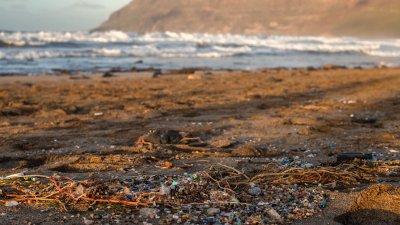
The Ministry of Ecological Transition and Energy of the Government of the Canary Islands, led by Mariano Hernández Zapata, drives the launch of a new marine litter monitoring program in the archipelago, within the framework of the European project CIRCULAROCEAN.
This initiative aims to improve knowledge about the presence and characteristics of waste on the Canarian coast, facilitating reliable data that allow designing more effective measures to reduce its impact on the marine environment.
The Minister of Ecological Transition and Energy, Mariano Hernández Zapata, has pointed out that “with this program we take an important step to better understand a complex problem such as marine litter and to be able to act with greater effectiveness”. In this regard, he highlighted that “having rigorous and comparable information is key to protecting our ecosystems and moving towards more sustainable waste management”.
The program, coordinated by the Ministry of Ecological Transition and Energy, will be developed starting this month of April through sampling campaigns in a total of 30 beaches on all the islands, including the islet of Alegranza, with a seasonal periodicity throughout the year.
Through these campaigns, data will be collected on the quantity, typology, and origin of the waste present on the coast, which will allow analyzing its evolution over time, identifying patterns, and improving the planning of measures for its reduction.
One of the main contributions of this initiative is the creation of a standardized data system, which will allow comparing the situation between different areas of the archipelago and aligning it with European methodologies, thus improving the quality of the available information.
The program has been developed in collaboration with the Marine Science and Technology Centre (CETECIMA) and SEO BirdLife, and responds to the need to overcome the current dispersion of existing data on marine litter in the Canary Islands.
International cooperation and circular economy
The CIRCULAROCEAN project is part of the INTERREG MAC 2021-2027 Territorial Cooperation Program, co-financed by ERDF funds, and brings together 15 entities from European regions such as the Canary Islands, Azores and Madeira, as well as from African countries such as Cape Verde, Ghana and Sao Tome and Principe.
Its objective is to advance towards a circular economy model in the marine field, promoting the reduction of waste and the improvement in its management through knowledge, cooperation, and the development of common tools.
In this context, the program promoted in the Canary Islands aligns with international initiatives for the protection of the marine environment and will contribute to strengthening the archipelago's position in the fight against waste pollution in the oceans.
Add La Voz de Lanzarote as a preferred Google source.
Stay informed with the latest current news.