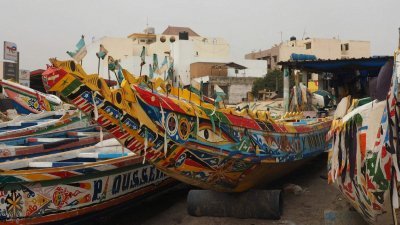
"There are many pirogues, but less and less fish is landed." The fisherman Cheikhou Mbengue's phrase summarizes the crisis in the fishing sector, a symbol of national identity in Senegal, which is pushing the country's youth to set sail for the Spanish Canary Islands.
In the coastal town of Yenne, about 40 kilometers east of Dakar, boats still occupy the beach, but industry professionals are finding fewer and fewer resources and facing more difficulties in making a living.
Yenne has also been the scene of numerous departures for the Canary Islands in recent weeks, the last one only a few weeks ago when four bodies were recovered after a cayuco carrying about a hundred people collided with rocks. For the young people of the fishing town, emigration has become an alternative to the loss of their livelihoods.
"Artisanal fishing has been disappearing for years," warns Mbengue, president of the Local Council for Artisanal Fishing in Yenne, who received EFE this week at the local union headquarters. A few meters away, dozens of pirogues rest on the sand, some of them converted into boats for irregular migration.
Mbengue denounces that fishermen can no longer support their families with the income from an activity that has been the main livelihood of coastal communities for generations.
In Senegal, a country of more than 18 million inhabitants and one of the youngest populations in the world, fishing is an economic and food pillar. The sector generates more than 53,000 direct jobs, accounts for 3.2% of GDP, and records annual landings of about 500,000 tons, 80% of which comes from artisanal fishing.
However, professionals denounce a crisis marked by a reduction in catches and the rising cost of fuel and ice needed to preserve fish. The drop in catches due to overexploitation and environmental changes has forced fishermen to spend more time at sea.
"A few years ago, we could find fish a short distance away and return in a day. Now we have to spend up to twelve days at sea and even reach the waters of Guinea-Conakry to find it," laments Mbengue.
He denounces the presence of large vessels in areas traditionally used by artisanal fishermen and calls on the Government to limit licenses for industrial fleets, whose activity he considers a threat to marine resources.
He also warns of the damage caused by large boats to the nets and gear of small vessels, as well as the risk of collisions, especially at night: "When there is a conflict between an industrial and an artisanal vessel, we are always the ones who lose," he laments.
Mbengue calls for greater control of the waters and a review of the Fishing Code to protect traditional fishing grounds. He also denounces the proliferation of fishmeal factories, which, he claims, encourage the capture of young specimens before they reach reproductive maturity.
The fishing crisis also coincides with the transformation of the territory and the reduction of economic alternatives. "We lived from fishing and agriculture: three months of rainy season and nine months of fishing. We used to live peacefully, without major problems," he recalls. Now, he adds, restrictions linked to oil activities, changes in land ownership, and the expansion of industrial fishing have altered that balance.
Amadou Ahmed Ndir, a businessman in the seafood processing sector and son of fishermen, knows the consequences of this crisis firsthand. In 2007, he created a fish freezing and processing company that employed about 140 people; currently, its workforce is reduced to about 40 workers during the low season.
"In the last four years, fish stocks have decreased considerably. We are in a sector in crisis," Ndir tells EFE from his home in Yenne, while warning that the reduction in catches affects the entire economic chain.
But his greatest concern is the emigration of the most experienced workers: "Among the people arriving in the Canary Islands, we are losing some of the best Senegalese fishermen. The most experienced, the bravest, those who know the sea best, are leaving," he states.
The businessman assures that some boats, built for millions of CFA francs, remain stranded due to a lack of workers to go fishing. "If we want to solve the problem of fishermen's migration, we cannot do it without first solving the fishing problem in Senegal," he maintains.
As a solution, he proposes installing solar-powered cold rooms, strengthening fish markets, and improving marketing channels to preserve catches and increase fishermen's income.
Mbengue, for his part, claims that the State should pay the same attention to the maritime security of coastal communities as it does to intercepting boats trying to reach Europe. He contrasts the resources deployed to control migratory departures with the difficulties that, he denounces, fishermen encounter when they need to activate a search and rescue operation.
"When a boat is lost at sea and we ask for help, we have difficulties getting them to search for it," he denounces.


Add La Voz de Lanzarote as a preferred Google source.
Stay informed with the latest current news.