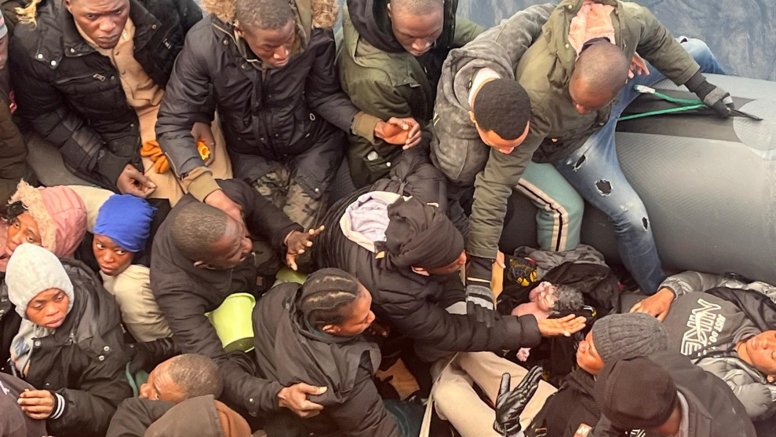
The cry of a newborn echoed in the middle of the Atlantic. That night the moon was waxing, and in the darkness of the early morning, its mother had given birth in a plastic boat surrounded by more than fifty people. It was the early morning of January 6, 2025, and while in Lanzarote they awaited the arrival of the Three Wise Men, a life was beginning on the deadliest migratory route in Spain.
The story of this baby, who came into the world on a makeshift vessel, stands in stark contrast to the thousands of others who died without managing to reach the Canary Islands' borders. Like that child, who was rescued along with his mother by Maritime Rescue, another 11,319 people arrived in the Canary Islands in 2025, according to data from the Ministry of the Interior.
The migratory route to the Canary Islands, known as the Atlantic route, has become the deadliest in Spain and one of the most dangerous in the world. Throughout last year, according to data released in the #DerechoAlaVida2024 monitoring report by Caminando Fronteras, a total of 1,906 people died in the Atlantic Ocean trying to reach the coasts of the Canary Islands.
In total, across the different routes to Spain, 3,090 victims were counted, 70.5% less than throughout 2024, when 10,457 people died, 30 a day, trying to reach Spanish territory. Despite the decrease, the figure is still alarming, with 437 children and adolescents dead and 192 women victims of the borders.
Nearly 245 dead from Moroccan and Sahrawi coasts
Wooden boats or rafts usually arrive more frequently on the eastern islands, including Lanzarote. Caminando Fronteras estimates that the crossing from Morocco or Western Sahara claimed the lives of 245 people. In total, ten tragedies were recorded between these two countries alone, with the disappearance of five entire boats.
The reinforcement of controls to prevent boats from leaving the Moroccan coast and Western Sahara occupied by Morocco means that boats increasingly have to leave from more remote areas and, therefore, more dangerous ones, as the journeys are longer.
"It was my first time at sea," the report quotes the testimony of a woman from Ivory Coast who survived on an inflatable boat. "We called by phone for help, but they told us that it was coming but no one arrived. When you are like that, a minute feels like hours, and in the end, the rescue arrived, but for some, it was too late," she continued.
Millions of euros to curb emigration in Mauritania
The migratory route to the Canary Islands remains the deadliest, although arrivals via this route decreased by 62%, according to data from the Ministry of the Interior.
One of the main reasons for this decrease is the strengthening of borders in Mauritania. Along these lines, a report by Human Rights Watch already denounced the racial persecutions, beatings, and arrests suffered by migrants who intended to set sail for the Canary archipelago from the African country.
In March 2024, the European Union paid 210 million euros to Mauritania after the signing of a new cooperation and migration control agreement. Spain pledged to add another 300 million euros and contribute ten million annually in police cooperation. This is in addition to other multi-million dollar initiatives to intercept boats on the high seas or exert greater migration control with the border with Mali, where there is an active armed conflict.
Young people from Mali are fleeing the country, escaping the armed conflict and to avoid being recruited by rebel groups. Another testimony gathered in the report presents a Malian father who is still waiting to hear from his son: "They tell me that his boat has not appeared, but I tell myself that maybe he is in the desert somewhere, kidnapped, and one day he will return."
In total, 1,319 people died and seventeen boats disappeared with all crew members on board between Mauritania and the Canary Islands. This outsourcing of borders, with billions of euros contributed by the European Union, has been repeated in other West African countries such as Senegal, Gambia, and Morocco with the reinforcement of patrols, border control, and control of irregular migration. Walking Borders states that the lack of protection causes boats to get lost in the Atlantic and end up arriving in the Caribbean or South America with all the migrants dead.
Deaths also rise in the Mediterranean
Only one other migratory route to Europe also surpassed a thousand deaths. Specifically, the Algeria route, where Caminando Fronteras puts the number of fatalities at 1,037 peopleThe Ministry of the Interior points out that the arrival of irregular boats to the Balearic Islands has grown by 24.5%, recognizing this route for the first time. However, the group rules out that the departures of migrants being contained in West Africa are increasing departures from Algeria, because the migratory profiles are different and come from different countries.
Most of the fatalities on these irregular routes to Europe occurred in the first two months of last year. In total, 1,434 people from up to 30 different countries died without managing to reach European territory. Additionally, 70 boats disappeared with everyone on board.
An increasingly distant route
The Walking Borders Collective confirms the trend of migratory flows that end up consolidating with boats departing from Gambia and the appearance of boats leaving from Guinea Conakry, on the west coast of Africa, becoming "the longest distance ever faced with the ocean as the only horizon."
From Gambia, it gathers up to 160 victims, while from Guinea Conakry, it counts eleven. Furthermore, in the latter, it points out that, against the trend of other boats, the majority of people traveling on them are Guinean women, children, and adolescents.
In this regard, he states that deaths on the different migration routes between Africa and Europe are not "accidental" or "inevitable," but rather a consequence of "a system that continues to prioritize border control over the protection of life."
Add La Voz de Lanzarote as a preferred Google source.
Stay informed with the latest current news.