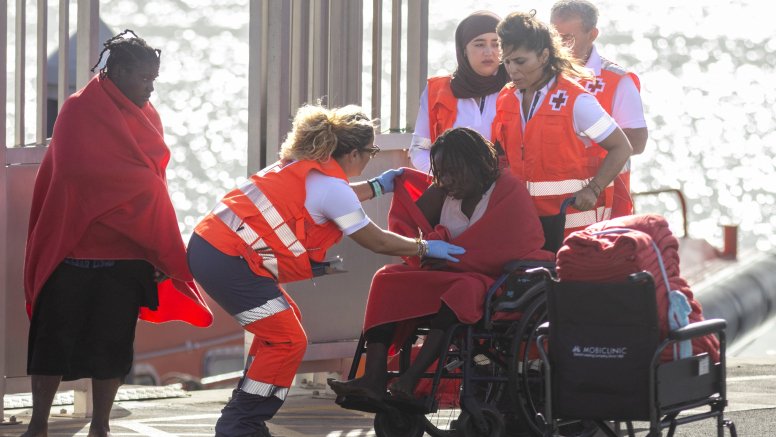
An inflatable boat left the Moroccan city of Tan Tan in mid-September with 82 people on board. However, not everyone reached their destination. 79 survivors were rescued at dawn by two Maritime Rescue boats and transferred to Lanzarote. Three of these people did not survive the crossing and one had to be urgently transferred by helicopter to Gran Canaria.
So far this year, arrivals by irregular means to the Canary Islands have decreased by 55.1%, according to data from the Ministry of the Interior. Despite this drop, the migratory route to the archipelago remains the deadliest in Europe and one of the most dangerous in the world. For every one hundred people who arrive, twenty-one die.
The journey, which for many people does not begin when they get on the precarious boat, is even more dangerous for women, who are more exposed to specific forms of violence and exploitation than their male counterparts. In fact, on the journey of that same boat, a Guinean woman reported being the victim of gang rape, a crime that could go unpunished due to the lack of jurisdiction of the Spanish courts, as it occurred in international waters.
"When viable alternatives are lacking, danger ceases to act as a deterrent," highlights a report commissioned by the Government of the Canary Islands and prepared by the Spanish Institute for Migration Analysis (EIAM). The text warns that, despite the containment of arrivals shown by the data, the structural and social causes that drive people to migrate have not disappeared. The route has been contained, but not deactivated.
"The young person who leaves does not only carry their own project, but also the investment and expectations of a family group," explains the research. In this way, a migrant person becomes a "bearer of hope" for an entire family and carries the responsibility of achieving success for their community.
In a context where irregular immigration is instrumentalized as a political weapon, the document invites to "overcome the Eurocentric reading" and reflects that most of the displacements in West Africa and the Sahel region occur within the African continent itself. "If Europe only pays attention to what arrives at its borders, it runs the risk of misunderstanding the deep dynamics," the document continues.
The conclusions of this research stem from the ideas exchanged by Canary institutional representatives, security forces, international organizations, and different actors involved in the migratory route towards the archipelago.
Driven into Clandestinity
Faced with this reality, the archive warns that economic and police efforts to curb departures of boats from Morocco, Senegal, and Mauritania towards Spain generate "a greater risk" for people seeking to start a new life in Europe. In the case of Senegal, Spain has deployed an operation for years with the National Police and the Civil Guard, along with the country's police forces, to reduce irregular departures. In 2025, the Ministry of the Interior reported 126 boats intercepted at the Senegalese borders.
The report states that the current decrease in arrivals may be more related to the "effort" of transit countries to curb departures (with more controls on their borders), with a longer wait in limbo for the opportune moment, and with people moving to increasingly distant points to escape these controls.
"Longer routes, riskier crossings, and greater dependence on intermediaries are appearing," the text points out. This outsourcing of borders leads to increasing criminalization in the countries of origin and transit of people trying to migrate and makes movements increasingly "clandestine, less visible, and more dangerous," with people resorting to ever riskier routes.
Faced with a border policy that seeks to control departures, the document exposes a "professionalization" of the criminal structures that organize irregular journeys, with payments "in stages," closed WhatsApp groups, and transfers between boats.
Furthermore, it reflects that the main departure points are from Morocco and Algeria, while corridors such as the one connecting a country in conflict like Mali with Mauritania and Senegal continue to grow, to which is added the recent creation of the route towards Gambia, Guinea, and Guinea-Bissau, further away from the archipelago and, therefore, even more dangerous.
The document also differentiates the realities of different countries. For example, regarding Mali, one of the main countries of origin for refugees in Spain, it points to the deterioration of security aggravated by conflicts, the increase in internal displacement, the loss of livelihoods, the difficulty of returning, or social pressure as factors that lead to migration. In this case, it speaks of "two uncertainties": "Staying without prospects or leaving despite the danger."
Combating criminal networks and opening safe corridors
In this regard, the research focuses on the need to attack the profitability of criminal groups, rather than undertaking judicial proceedings against "low-level actors" or the migrants themselves. It also emphasizes that this situation is not a challenge solely for the Canary Islands, but is a European and African issue.
To counteract the human risk generated by irregular migration, the research addresses the importance of offering safe humanitarian corridors for people seeking to migrate and, in turn, reinforcing legal and circular mobility. "Legal pathways cannot be merely symbolic," the document highlights, advocating for a more effective visa policy, betting on circular mobility and vocational training opportunities.
Migration as a family and not individual decision
At the same time as emphasizing safe migration routes, it proposes that investment in cooperation be rethought to move away from the logic of containment and support local governments and economies in the territories so that families and diasporas can reintegrate.
The document highlights that in different parts of West Africa, migration becomes a "family and community" decision. Young people who embark on a raft often receive financial support from their families, who incur debts to pay for the journey. At the same time, the research points out that social networks are also playing an essential role in migration dynamics by serving as a loudspeaker for success stories and minimizing the risks of the journey.
Meanwhile, it invites a rethinking of the terminology regarding minors traveling without their parents. The report explains that many actually have family members who support them or members of their community, but that sometimes the way to protect them has been to take them out of the country.
Finally, it highlights that territories like the Canary Islands, with more than thirty years of experience as a migratory destination, must be part of the national and European decisions that shape the future of migratory policy.
Add La Voz de Lanzarote as a preferred Google source.
Stay informed with the latest current news.