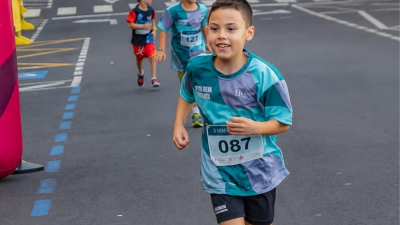
There is a wide variety of therapies for people with autism, but in the case of the Lanzarote native Adrián Rodríguez (Costa Teguise, 2018), running has improved his life and that of his parents exponentially. With around forty participations in races alongside his father, Plácido Rodríguez, this child with Autism Spectrum Disorder and a 42% disability is managing to overcome the obstacles inherent to this condition thanks to sport.
Through his Instagram profile (@adrianri_2018), his father shares Adrián's entire process through the different races in which he participates and in which he overcomes his own limits.
After being diagnosed with Autism Spectrum Disorder, this little one's parents got to work to ensure their son had the maximum possible quality of life and independence. Families with children with this condition are forced to face difficulties in social communication and interaction, restrictive or repetitive behavioral patterns, and differences in sensory processing.
His father defines Adrián Rodríguez as a "happy child" who "adapts" to situations. "He is understanding more and more, and although he is not verbal, through my repetition he is starting to say a few words," he says.
Running as therapy
Plácido Rodríguez says that the little one's introduction to running was by chance. To keep his son entertained, he has always tried to keep him busy at home with different activities and avoid television and cartoons "because, moreover, he internalizes them a lot."
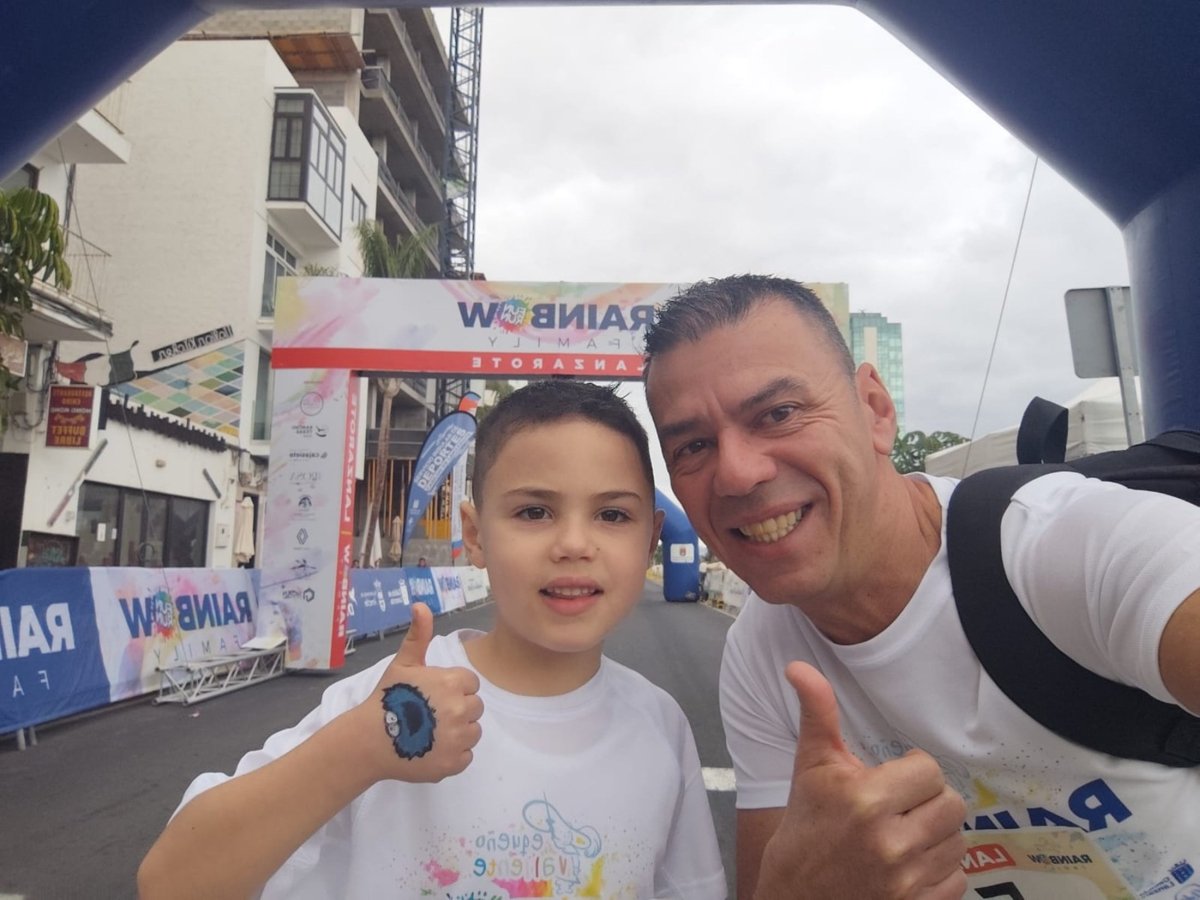
Following the arrival of Rainbow Family Lanzarote on the island in January 2025, a solidarity race for the whole family benefiting the Pequeño Valiente Foundation, his father decided to take Adrián to the mats for a pleasant day. "We did the race and the surprise was that the boy ran straight, he didn't veer off to the sides or stop, and that's when I said to myself: why not?", he recalls.
During the following months, father and son went to the avenue in Costa Teguise to continue with this training. At this point, his father Plácido decided to create his Instagram profile to reach more parents. "Since he doesn't have friends, maybe some mom would bring her child to run too," he comments.
The days his father took him with the little one to the avenue, they walked and ran. "He tickled him, as if it were a game of tag, and little by little the child gained more distance," he recounts.
His adaptability also extends to the types of terrain where Adrián runs the races, whether on sand, cobblestones, dirt, or asphalt. "He understands the activity as something he's having fun with," he says.
According to his father, Adrián's therapists "can't believe how the child has managed the routine of starting and finishing the races, of not veering off to the sides, knowing what he's doing and enjoying what he's doing." Furthermore, Plácido always goes with his son, supporting him in every step he takes in the races. "I talk to him and tell him: come on Adri, your hands, come on, we're reaching the finish line, very good," he details.
A way to adapt to daily life
After the first training sessions, Plácido found a National Police race to participate in with his son in Tenerife. "It helped me discover a whole therapy because now the child was going to work on waiting for the plane, he was going to go sit on it, the taxi ride, the hotel, and eating out," he explains.
This allowed both of them to find a way to spend time together while Adrián worked on his social interaction, behavior, and emotions, as well as his motor skills. "The race went very well, the child ran 400 meters, although it's true that when he reached the finish line he covered his ears because there was a lot of noise, but even so, he didn't stop running the race," he recalls.
Shortly after this event, his father registered him for another race, this time in Gran Canaria. On this trip, Adrián continued to adapt. Later, he has participated in other races such as the Wine Run or the Trail La Vegueta, as well as others on the other islands. In total, Adrián has managed to travel around 15 trips to all the islands, except El Hierro, and has completed forty races.
"He's perfecting it more and more, it's true that in some races he moves his hands more, depending on his state or if the race is in the morning or afternoon because it's not the same," he clarifies.
Several activities to improve his life
The different activities that little Adrián does make his life improve by leaps and bounds, from going to the beach, contact with animals like horses, to the races he regularly participates in. "Now he has so many activities that he is focusing on them very well and understanding them like any other child," his father indicates.
Due to his condition, Rodríguez suffers from continuous stereotypies and echolalias, that is, repetitive behaviors associated with autism that these individuals use as tools for their emotional and sensory self-regulation. Thanks to a small toy robot that always goes with him, Adrián manages to cope better with his routine. "He holds on tighter and, for example, if he's going to get on a plane, he walks straighter with the doll and doesn't wander off, nor does he throw himself on the floor or start running," he explains.
Now, his father takes him to train in paleo so that he can perform functional activities. "You see him laughing, happy, dynamic, and trying to interact," he assures.
Rodríguez says that what he has learned these years of struggle with his son is to "do" and "not stay at home, sit him on the couch, give him the tablet and put on cartoons". "You have to understand that it is a very difficult situation because he is not a child who sits down, starts playing, and you can go do other things because you can't take your eyes off him," he explains.
In this regard, he acknowledges that doing different activities means "sacrificing your life to give it to him". Plácido dedicates his day to his son, while at night he takes the opportunity to do his chores. "Some nights it gets to be one in the morning," he reveals. However, he points out that every family is different and that "not everyone can" carry out the same activities. "If they tried, they would be surprised, because maybe the child has the capacity to do many things, although you have to understand that every child is different," he details.
The reality of this family is that sports have greatly helped in fighting Adrián's condition. "My day-to-day life with him now is nothing like when he was five years old because he might show his joy by pinching my face or not walk, but the evolution he has had in being constant in a routine has led him to improve tremendously," he concludes. "Years ago, this was unthinkable," he adds.


Add La Voz de Lanzarote as a preferred Google source.
Stay informed with the latest current news.