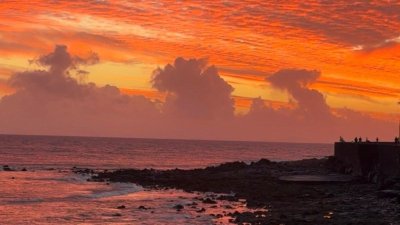
Few days are left until the arrival of the lunar eclipse in Lanzarote, a phenomenon that will have 93% visibility in which reddish and orange hues can be observed. Although this is not the only time we see these colors when looking at the sky, sometimes sunsets are tinged with warm colors, leaving unbeatable images, why is this similarity due to?
Sunlight does not have a single color, it emits an rainbow of colors that results in white, but we can see other colors due to different circumstances when projecting on Earth, such as due to oxygen, solar blocking, or the atmosphere.
Water has one color or another depending on where you see it. Seawater is not actually blue, it is transparent as can be easily observed in the water we drink every day. However, the optical vision of the color blue is due to the fact that the molecules react in such a way that the color blue bounces towards our vision, unlike warm colors which get trapped in the molecules.
When a lunar eclipse occurs, the Earth blocks sunlight and the Moon reflects our planet's shadow, in which the atmosphere filters the colors, deflecting the cool tones and projecting the warm ones like red and orange.
Something similar happens at sunset, when the Sun is on the horizon, the colors that the atmosphere filters are different from the light of broad daylight, the blue hue is deflected, letting the warmer colors pass through.
Likewise, the difference in sunsets each week is due to other factors to consider: the season we are in, the clouds located, and the rains, among other circumstances.


Add La Voz de Lanzarote as a preferred Google source.
Stay informed with the latest current news.