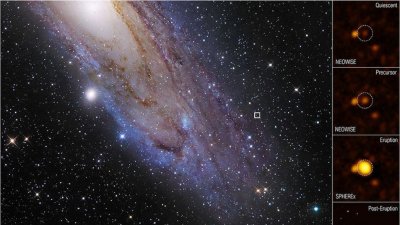
A scientific team has presented the first direct observations of the process by which a companion star merges with a dying host star in a binary system, on the periphery of the neighboring galaxy Andromeda.
The event, known as AT 2025abao, offers a more complete view of the process that helps shape nearby stellar systems. The details of this exhaustive follow-up are published this Wednesday in the journal Nature in a paper led by astronomers from Columbia University (United States), and in which researchers from the Institute of Astrophysics of the Canary Islands (IAC) have participated.
As a star dies, it expands, engulfing any celestial body orbiting around it. In a binary star system, this can include the absorption of another star.
When a companion star begins to interact with the outer surface of the primary star, a subtle effect occurs, a gradual increase in brightness.
As the companion continues its orbit, it strips the primary star of its outer layers, and that gas disperses into the surrounding space.
This is the beginning of a critical process experienced by some binary stars known as "common envelope evolution."
At this stage, the gas between the stars is called the common envelope, because the outer layer is shared by both. In the system analyzed, the primary star enveloped the smaller one, and the companion spiraled down through the envelope, losing orbital energy due to friction.
While the data confirmed that the stars merged, the merger was not the only possible outcome.
This process of approach had never been directly observed in such a system. The star, which was left alone and possibly "rejuvenated," was named Bao.
Viraj Karambelkar, from Columbia, along with researchers from other institutions, presents an analysis of the observations of AT 2025abao, an erupting point of light in the Andromeda galaxy.
The finding, funded by NASA, was supported by observations from the James Webb Space Telescope, whose data were meticulously cross-referenced with information from other telescopes, both space-based and ground-based.
Researchers discovered that the spot was a binary star system, in which an aging host star—with a mass seven times that of the Sun—was expanding and consuming its smaller companion star, which had approximately 0.7 solar masses.
In 2018, the smaller star entered the outer layer of the larger star and began to spiral inward over the next seven years.
By the end of 2025, the system emitted a bright eruption, indicating that the companion star had merged with the primary star. The eruption expelled between 0.1 and 0.2 solar masses of material.
Stellar mergers are extremely difficult to observe in real-time, as they are very complicated to predict, Karambelkar notes on the NASA website.
The Webb, he details, observed Bao just 47 days after the eruption peaked: "This is the earliest follow-up ever conducted of such an event."
The data obtained allowed for the characterization of the system's state before, during, and immediately after the merger, "which is simply amazing," the astronomer adds.
However, future observations will be needed to conclusively confirm that the two stars merged.
Jason Nordhaus, of the Rochester Institute of Technology, United States, notes in a commentary on this work—also published in Nature—that this discovery comes at an exceptional time.
Upcoming astronomical surveys (...) will generate unprecedented amounts of data in the form of time series.
Facilities such as the Vera C. Rubin Observatory, in Chile, and the Nancy Grace Roman Space Telescope should, therefore, routinely detect common envelopes in hundreds of nearby galaxies.
"This crucial and elusive phase of stellar evolution will be able to be mapped and revealed; not because stars are quiet, but precisely because they are turbulent," he points out in his writing.
Researchers from the Institute of Astrophysics of the Canary Islands, the Institute of Cosmos Sciences of the University of Barcelona, and the Institute of Space Studies of Catalonia are participating in the work.



Add La Voz de Lanzarote as a preferred Google source.
Stay informed with the latest current news.