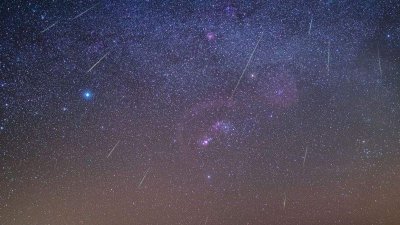
Nature has prepared for Lanzarote a double unprecedented astronomical milestone in a single day. This Wednesday, August 12, attention will first be focused on the horizon around 7:52 PM, the moment when the solar eclipse will reach its peak at sunset. However, the spectacle will not end with the sunset: that same night, the peak of the Perseids will arrive, offering the island a unique stellar marathon from evening to dawn.
After the passage of the eclipse, the arrival of night will bring with it the peak of the popular "Tears of San Lorenzo". On this occasion, the event has an exceptional ally: the new moon. The coincidence with the lunar darkness phase will guarantee a sky completely free of glare, which will allow even the faintest trails to be appreciated with an estimated frequency of up to one hundred meteors per hour under the most optimal conditions.
Schedules for an unforgettable marathon
The astronomical event will be marked by two key moments during the day of August 12 to 13:
-
7:52 PM (August 12): Peak moment of the solar eclipse in the final stretch of the afternoon.
-
3:00 AM to 5:00 AM (early morning of August 13): Ideal window of maximum activity to observe the Perseids.
To contemplate the shooting stars, no type of equipment is required. The use of telescopes or binoculars is counterproductive because it reduces the field of vision. The fundamental recommendation is to find a comfortable position, lie on your back, and direct your gaze preferably towards the Northeast, although the flashes may cross any point of the celestial dome.
Key points in Lanzarote to escape urban light
To fully enjoy the meteor shower after sunset, it is essential to move away from the light pollution of urban and tourist centers such as Arrecife, Puerto del Carmen, Costa Teguise, or Playa Blanca.
Among the most recommended spots on the island are the high areas of the north, such as the surroundings of Peñas del Chache or the vicinity of Haría and Guinate, as well as the interior landscapes away from public lighting.
Practical recommendations
Emergency services and astronomical groups remind residents and visitors who will be traveling at night of a series of basic guidelines:
-
Patience and adaptation: The human eye takes between 20 and 30 minutes to adjust to darkness. It is advisable to avoid using mobile phone screens or white light flashlights.
-
Caution on the road: Vehicles are requested to be parked exclusively in designated areas so as not to obstruct roadways or invade protected natural spaces.
-
Warm clothing: Despite it being summer, the drop in temperatures inland and in the high areas of the island during the early morning makes it advisable to bring warm clothing or blankets.
Origin and name of these "shooting stars"
Behind this annual phenomenon is the comet 109P/Swift-Tuttle. On its journey around the Sun, this celestial body leaves behind a gigantic trail of dust and small rock fragments. Every August, the Earth crosses this cloud of debris in its own orbit. Upon entering the Earth's atmosphere at speeds exceeding 210,000 kilometers per hour, these particles—most of them as small as a grain of sand—instantly incinerate due to air friction, leaving the characteristic luminous streaks.
Their name, Perseids, comes from the constellation Perseus. Although the meteors cross the entire sky, if their trajectory is projected backward, they all seem to emerge from the same point of origin in the sky (called the radiant) located precisely in this constellation.
Add La Voz de Lanzarote as a preferred Google source.
Stay informed with the latest current news.