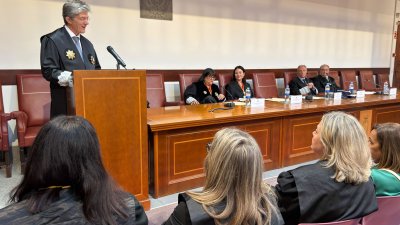
Carlos Enrique Viña Romero, current dean of the Illustrious Bar Association of Lanzarote, took office as the new president of the Canarian Council of Bar Associations, along with his Governing Board, in a solemn ceremony that took place on the afternoon of Friday, June 12, in the auditorium of the Illustrious Bar Association of Las Palmas. Carlos Enrique Viña Romero thus succeeds Juan Antonio Rodríguez Rodríguez, outgoing dean of the Illustrious Bar Association of Santa Cruz de La Palma, in the position of president of the Canarian Council of Bar Associations.
The new president of the Canarian Council of Bar Associations thanked at the beginning of his speech the presence of various judicial, political, and social authorities from the Archipelago and the nation, “among many other colleagues and friends, to whom I thank from the heart for their presence at this solemn event in which we vindicate the essential value of Canarian advocacy”.
Carlos Enrique Viña Romero also expressed words of gratitude to the outgoing president, Juan Antonio Rodríguez Rodríguez, whom he praised for his management at the head of the Canarian Council of Bar Associations at a time “of many changes,” he noted. During the last year, and with the predisposition of the Canarian Council of Bar Associations, “a just claim of Canarian advocacy has been achieved to adapt the free legal aid services to the real cost. This remuneration had not been updated since 2008, an improvement that has benefited the more than 2,300 professionals who provide free legal aid in the Canary Islands and, therefore, the users of this service,” recalled Viña Romero.
During his review of an intense year, the new president of the Canarian Council of Bar Associations highlighted the close collaboration maintained with the Ministry of the Presidency, Public Administrations, Justice and Security of the Government of the Canary Islands, headed by Nieves Lady Barreto, which has allowed the implementation in May 2025 of “the Canarian model of Appropriate Dispute Resolution Mechanisms (ADRM), with the largest pay difference in Spain among procedures with an agreement, with the aim of incentivizing the policy of agreement before resorting to judicial channels, as a firm commitment to reduce litigation,” he pointed out.
This new compensation system has come to consolidate the key role of the legal profession as "a protagonist of a more agile, efficient justice focused on the agreed-upon resolution of conflicts, avoiding, as far as possible, recourse to the judicial route," stressed Carlos Enrique Viña Romero. An advance that not only dignifies the legal profession, "but also reinforces our ethical commitment, fully aligned with the principles of the Code of Ethics and the General Statute of the Legal Profession: the defense of harmony, dialogue, and alternative dispute resolution methods as fundamental pillars of our social function," assured the new president of the Canary Council.
The recent reform of Organic Law 1/2025, of January 2, introduces a profound transformation in civil and commercial proceedings and in the judicial organization in Spain. "The efficiency of the public justice service is boosted with measures that directly affect legal practice, the establishment of new admissibility requirements, and the reorganization of the judicial system," stated the new president of the Canary Council.
In this context, Carlos Enrique Viña Romero highlighted "the essential work of the legal profession as a fundamental pillar of the Rule of Law. In times of disorganization and change like the ones we are experiencing, the work of the legal profession guarantees the right to defense, legal certainty, and access to justice for citizens." Far from being a mere bureaucratic procedure, having expert legal assistance "is the main guarantee that laws are applied with all guarantees, especially in the face of current challenges. I am convinced that honest work and institutional collaboration by the legal profession will be indispensable to overcome any crisis," acknowledged the new president of the Canary Council.
"The legal profession is our livelihood. That is why lawyers are the first to be interested in the current situation improving, because it will also mean a direct benefit for citizens," he added.
In relation to free legal aid and the duty lawyer system, the new president of the Canary Council of Bar Associations underlined the important work carried out by Canary lawyers in the duty lawyer system to assist the most vulnerable people, "as a guarantee of the democratic system." For this reason, argued Viña Romero, "the Canary Council will continue to be present," in collaboration with the Ministry of the Presidency, Public Administrations, Justice and Security of the Government of the Canary Islands, "to support professionals dedicated to the duty lawyer system. And we will continue to ask for greater investments, better facilities and personal resources in the permanent pursuit of a swift, effective and up-to-date justice system, regardless of the outcome. Sometimes we will win and sometimes we will not. But it is fundamental for legal professionals and for citizens that we have a swift and efficient justice system," explained Carlos Viña.
During his speech, the new president of the Canary Council of Bar Associations also highlighted "the essential role of the legal profession in our society and in Democracy," valuing "respect for the different administrations and for the legal profession by them."
The new president of the Canary Council also did not want to forget the male and female lawyers who have dedicated their entire lives to the practice of the profession and who have been demanding a "fair and necessary" transition to the RETA. "Because it is and will always be just that they achieve the professional dignity they deserve."
The new president of the Canary Council of Bar Associations expressed his satisfaction with the approval in the Congress of Deputies, last Thursday, June 11, of the Opinion on the Bill on Alternative Mutual Societies, with the sole inclusion of the amendment to the 47th transitional provision. Although the text must continue to improve, as the Spanish General Council of Lawyers recalled yesterday, Carlos Viña Romero wanted to join "the historic and decisive moment that brings a long-demanded solution by thousands of professionals closer."
Carlos Enrique Viña Romero concluded his speech expressing his wish that the Canary Islands Bar Association, in collaboration with the professionals of each of the four Canary Islands colleges, continues to play a key role as guarantor of fundamental rights and legal certainty in migratory processes. “In the context of the extraordinary regularization in which we are immersed, and in the course of the irregular migratory flows that arrive and will continue to arrive in the Canary Islands, the institution will support the legal professionals who carry out their work on the front lines, as a guarantee to protect a highly vulnerable group, demanding an ethical, transparent, and qualified practice of the profession”.
The Governing Board is made up of the following members:
President: Carlos Enrique Viña Romero
First Vice-President: Milagrosa Pacheco Pérez
Second Vice-President: Rafael Massieu Curbelo
Third Vice-President: Nieves Cruz Pérez Rodríguez
Secretary: Agustín Guillermo Santana Santana
Treasurer: María del Pilar Rodríguez Martín
Member: Francisco Montes de Oca Acosta
Member: Eloisa Merino Morillas
Member: Esther Medina Castilla
Member: Leopoldo Escobar Martínez de Azagra
Member: Pino López Acosta
Member: Elena Isabel Ruiz Suárez
Member: Francisco Kabir Yaswani Reboso
Member: Francisco González Cordón
Member: José Manuel Mentado Batista
Member: María del Pilar Rodríguez Martín
Member: Carolina García Santos


Add La Voz de Lanzarote as a preferred Google source.
Stay informed with the latest current news.