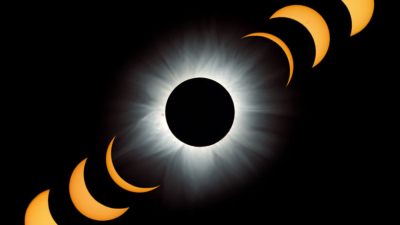
The Canary Islands Institute of Astrophysics (IAC) will deploy a large team of researchers and technical personnel in multiple Spanish locations for the August 12 solar eclipse to carry out scientific, outreach, and observation activities related to the phenomenon.
The epicenter of this deployment will be in Palencia with the international NATE (North African Telescope Eclipse) project, led by the IAC in collaboration with the Mohammed VI Polytechnic University (UM6P) of Morocco and the National Solar Observatory (NSO) of the USA, and supported by the Government of the Canary Islands and the Palencia City Council.
A note from the IAC recalls that from August 8 to 12, Palencia will host a complete scientific and cultural program that will test techniques for studying the solar corona in preparation for the 2027 eclipse in North Africa.
The main event will take place on the afternoon of August 12 at Cerro del Otero, where the public can witness the NATE team's experiments live, streaming broadcasts, outreach talks by Valentín Martínez Pillet and Alejandra Goded, observation of the Perseids, and a concert by the Opus One orchestra performing Mike Oldfield's trilogy (Tubular Bells, Hergest Ridge, and Ommadawn).
In parallel, IAC staff will be mobilized in different parts of the country, such as the Solar MHD Congress taking place in La Coruña, a meeting that will bring together researchers from around the world during the week of the total solar eclipse on August 12, 2026, an exceptional phenomenon that will position Spain as the epicenter of solar observation globally.
According to the note, the Canary Islands Institute of Astrophysics (IAC) plays a key role in this scientific event as the local organizing committee, led by Elena Khomenko, in collaboration with CITIC, the University of A Coruña, and the University of La Laguna.
The main objective of the conference is to delve into solar physics by analyzing the behavior of plasmas under magnetic fields through high-precision observations and computational simulations.
Specialists will address challenges such as solar flares, the use of artificial intelligence for large data volumes, the measurement of magnetism, and the application of new numerical codes to better understand the Sun's atmosphere.
The coincidence with the solar eclipse of August 12 offers a unique scientific opportunity to study the solar corona, the outermost layer of the Sun's atmosphere, the note indicates.
For its part, the international conference SUBSTELLAR ASTROPHYSICS 2026 will be held from August 10 to 14 near the historic town of Tordesillas (Castilla y León, Spain), it will bring together research staff to analyze advances in the study of substellar objects — a key field that connects stars, exoplanets, and the Solar System.
The meeting will place a special focus on the exploitation of data from the ESA's Euclid space mission, combined with observations from telescopes such as JWST, Nancy Grace Roman, or Rubin LSST and a new generation of theoretical models.
In addition, another important team from the IAC will travel to the Borobia Observatory to participate in outreach activities on the occasion of the total solar eclipse.


Add La Voz de Lanzarote as a preferred Google source.
Stay informed with the latest current news.