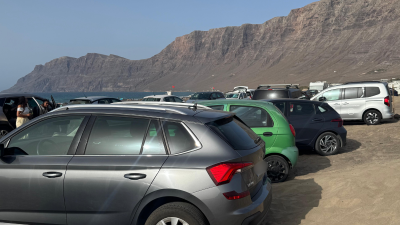
The Famara beach, in the municipality of Teguise, is one of the most special natural sites on the island of Lanzarote and also one of the most frequented by residents and tourists. Around six kilometers of beach lead to the Risco, where Lanzarote's highest peak, Peñas del Chache, rests. Despite its beauty, this protected natural space suffers the consequences of mass tourism.
The protection on paper does not extend to this fragile territory in practice, where hundreds of cars trample this dune area on days of greatest influx. The image is no longer new in Lanzarote, as Famara is one of the most popular tourist attractions among visitors.
In this protected area, there are updated signs indicating the prohibition of straying from the paths, which prevents motor vehicles from accessing the dunes, where people are asked not to litter and to respect animals. Furthermore, making bonfires, flying drones, or camping is prohibited. However, these prohibitions are not always respected.
Despite the mobility plan approved by the Teguise City Council, which filled part of the town of Caleta de Famara with parking spaces and was criticized by residents, the accumulation of vehicles in the natural space does not cease.
The European directive prioritizes its conservation
On Famara beach rests a priority habitat of community interest, the natural space of fixed dunes with herbaceous vegetation, also known as grey dunes. This type of dune is characterized by "low mobility," where sand dunes are usually fixed by vegetation, which plays a fundamental role in their conservation.
The Canary Islands have 24 natural habitats out of the 168 listed by the European Union. Of these, seven present a greater need for conservation. Fixed coastal dunes with herbaceous vegetation, as is the case with those in Famara, are one of them.
Sources from the Cabildo de Lanzarote explain to La Voz that vehicles parked on the dunes can be fined 360 euros (with discounts applied) for damaging the environment. These infractions are sanctioned by the Nature Protection Service (SEPRONA) of the Civil Guard, insular environmental agents, and the Local Police of Teguise.
In the European directive, under which these types of spaces are protected, priority natural habitats, such as that of Famara, are those that are threatened with disappearance and, therefore, their conservation is "a special responsibility" for the European Union.



Add La Voz de Lanzarote as a preferred Google source.
Stay informed with the latest current news.