In just over an hour of walking, biologist Rosa Betancort counts eighty butterflies on the Islote del Mojón, a patch of ancient land surrounded by a sea of lava where plants grow that are food and breeding grounds for these pollinating insects.
Since 2019, Timanfaya National Park, managed by the Ministry of Ecological Transition and Energy of the Government of the Canary Islands, has participated in the butterfly monitoring program of the Network of National Parks. Sampling is done in spring, from March to June, and in autumn, during September and October, always in Montaña de Mazo and on the Islote del Mojón.
In Timanfaya, the only predominantly geological park in Spain, the three most abundant butterfly species are Vanessa cardui (almost 80% of records), Polyommatus celina, and Colias crocea.
At the end of summer, the Painted Lady embarks on a very long journey of 12,000 kilometers in search of a favorable climate and resources to feed on. Its journey is similar to that of some birds, only it requires six generations to complete, reproducing at each 'stopover': it takes flight in Europe, crosses the Mediterranean Sea, traverses the Sahara Desert, and reaches tropical Africa in autumn. It stays in the Canary Islands and the sub-Saharan region during the winter months. When temperatures begin to rise, the offspring of these butterflies will fly towards Europe.
It is one of the most abundant butterflies in the Canary Islands. The underside of its wings is orange and pink. The hindwings show a striking pattern in brown and white, dotted with four small circular spots with bluish reflections. It lays its larvae on plants such as the small mallow (Malva parviflora), narrow-leafed forskaol (Forsskaolea angustifolia), or grapevine (Vitus vitifera). As an adult, it feeds on the nectar of up to forty different plants.
“A year without rain means no plants grow for the butterflies to complete their reproductive cycle. Adult specimens feed on nectar, water, and minerals from the soil; it is very common to see them licking mud to mineralize, but the caterpillars feed exclusively on leaves,” the biologist clarifies.
Butterflies are particularly “sensitive to pollution.” The healthier an ecosystem is, the more these pollinating insects will thrive, which in turn are part of the diet of numerous birds.
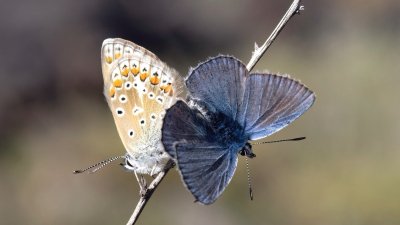
The brilliant violet blue of Polyommatus celina, a butterfly found only in Lanzarote and Fuerteventura, is the color that males display to attract females and mate with them. Their pupae feed on the leaves of chabusquillo (Astragalus solandri), corazoncillo (Lotus lancerottensis), and clover (Trifolium campestre).
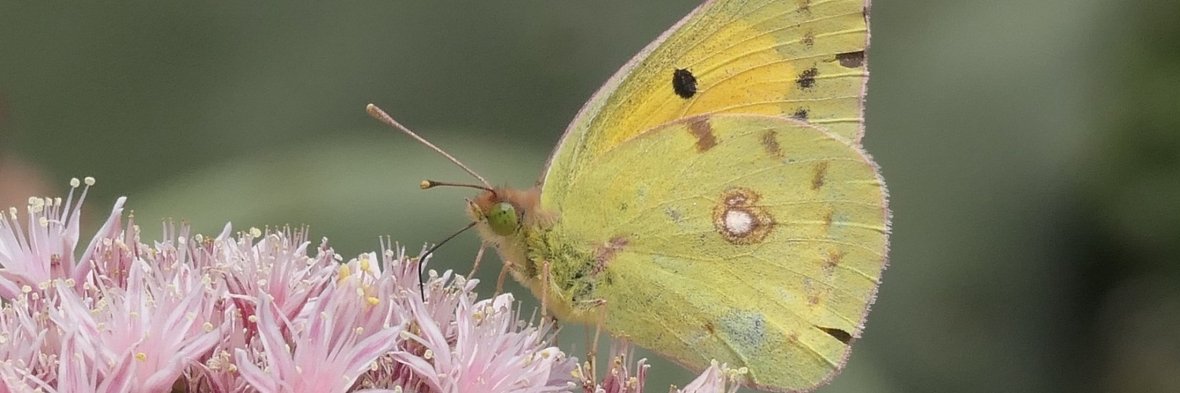
Yellow and with a dark stripe on the edge, Colias crocea is native to the Canary Islands and is the third most abundant butterfly in the Lanzarote national park. Its caterpillar feeds on the leaves of corazoncillo (Lotus lancerottensis).
“Butterflies are recognized by their color pattern and wing markings. Once contact is established, the pheromones emitted by the male play a decisive role in reproduction,” explains the scientist.
Their wings are covered by tiny scales that, like the tiles on a house, form patterns that help them camouflage or find a mate. When handled, these scales can detach and affect essential functions for the survival of this animal. The best way to enjoy a butterfly is to observe it from a distance and let it continue its flight.
Add La Voz de Lanzarote as a preferred Google source.
Stay informed with the latest current news.