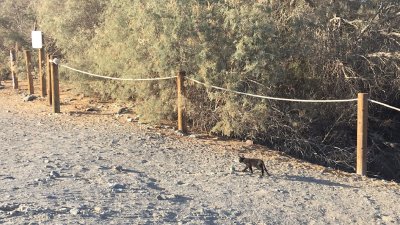
SEO/BirdLife has called on the General Directorate of Natural Spaces and Biodiversity to advance the administrative procedure initiated after the complaint filed a year ago regarding the release of cats in La Graciosa. In a letter, it has requested "detailed information" on the processing of this file and calls for "the urgent adoption of measures" to prevent "additional damage to biodiversity" from being generated.
Thus, the Spanish Ornithological Society has recalled that this complaint publicly exposed the release of at least one hundred cats in July 2024 in the Chinijo Archipelago Natural Park, as well as in other protected areas integrated into the Natura 2000 Network. According to the environmental organization, this action would have been carried out without the required environmental assessment or authorization from the managing body.
A year later, SEO/BirdLife denounces the "absence of administrative response," which, in its opinion, "violates the legal obligation to issue an express resolution and limits the right of access to environmental information and justice in environmental matters."
In its letter, the organization requests to know if investigations, sanctioning proceedings, or precautionary measures have been initiated, and asks to be recognized as an interested party in the procedure, by virtue of its role in defending the general interest in biodiversity conservation.
New scientific evidence on the impact of cats
As a key element, SEO/BirdLife has submitted to the file a recent study (Rodríguez et al., 2026) recently published in the journal Biology Letters, which analyzes the effects of cat colonies on endemic Canarian fauna.
The study clearly reveals that the presence of cat colonies alters the natural balance. In nearby areas, for example, there are fewer lizards, and furthermore, those that survive tend to be smaller, because cats preferentially hunt the larger specimens. This not only reduces the number of individuals but also weakens the entire population, as the colonies function as points where animals disappear faster than they can recover.
Furthermore, it is demonstrated that feeding cats does not prevent them from continuing to hunt wildlife, so the impact continues. Added to all this is that the trap, sterilize, and return (TSR/TNR) system, although widely applied, does not effectively reduce the number of cats in the long term, thus maintaining constant pressure on biodiversity.
The study, carried out by a team of researchers from the CSIC and the ULL, also warns that these impacts have cascading effects on island ecosystems, as lizards are key species both as prey for birds and as seed dispersers.
Although the work focuses on reptiles, its conclusions are extrapolable to other species, including seabirds, which are especially vulnerable in island ecosystems like La Graciosa.
Risk to protected areas
SEO/BirdLife emphasizes that La Graciosa is part of the Natura 2000 Network and hosts seabird colonies of high ecological value, so the presence of introduced predators poses "a direct threat to protected species."
The organization also recalls that Law 7/2023 on animal welfare requires the management of feline colonies to avoid negative impacts on biodiversity, even contemplating the removal or relocation of animals when there are risks in protected areas or to wildlife.
Request for urgent measures
Given this situation, SEO/BirdLife calls on the Administration to act with urgency and transparency. On the one hand, it asks that the new scientific study be incorporated into the file and its conclusions be taken into account when making decisions; on the other hand, it asks that immediate measures be adopted to reduce the impact on fauna, such as the removal of cats from this protected area and their relocation. Likewise, the organization demands to know clearly what actions have been taken so far and to be able to access all the information of the procedure, to ensure that the management of this case is carried out with rigor and in accordance with current environmental legislation and thus guarantee the conservation of an area with great environmental value such as La Graciosa.
“The scientific evidence is clear: cat colonies, even when managed, have a significant impact on biodiversity. In protected areas like La Graciosa, administrative inaction exacerbates the risk to unique species,” states Yarci Acosta, delegate of SEO/BirdLife in the Canary Islands.
SEO/BirdLife insists on the need to reconcile the protection of animal welfare with the conservation of biodiversity, especially in island territories where native species have evolved without terrestrial predators and are particularly vulnerable



Add La Voz de Lanzarote as a preferred Google source.
Stay informed with the latest current news.