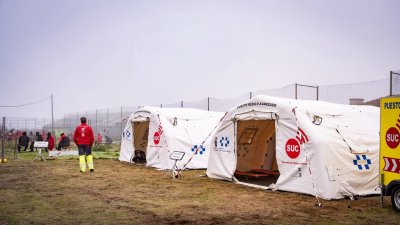
The Government of the Canary Islands has deployed a field hospital in El Hierro to strengthen healthcare services due to the increase in arrivals of migrants and to ensure that this situation does not affect the care received by the local population. The facility, installed next to the Temporary Foreigner Care Center (CATE) in San Andrés, Valverde, will allow for the treatment of minor ailments without the need to transfer patients to the Nuestra Señora de los Reyes Hospital, thus relieving pressure on the hospital and its professionals.
The president of the Canary Islands, Fernando Clavijo, visited the facilities accompanied by the director of the Canary Health Service, Adasat Goya; the director of the El Hierro Health Area, Pilar Mora; the manager of Health Services on the island, Jéssica Acosta, and island authorities. During the visit, he explained that the regional government decided to undertake the deployment after its request for the Red Cross, the Military Emergencies Unit (UME), or SAMU to provide this resource was unsuccessful, a need that had been raised in interministerial meetings on migration.
Clavijo especially thanked the collaboration of the mayor of Valverde, Carlos Brito, who provided the necessary land to install the field hospital, and acknowledged the effort of the healthcare professionals of the Canary Health Service who, in recent weeks, have had to make an extra effort to respond to the increase in healthcare activity on the island. The president highlighted "a commitment that went beyond their professional obligations and allowed for care to be maintained in particularly complex circumstances."
The recognition extended to the personnel of Salvamento Marítimo, Policía Nacional, and Guardia Civil, as well as to the volunteers who have participated in assisting migrants. Clavijo valued the solidarity of the people of El Hierro and the professionals who, despite the difficulties, "have guaranteed at all times a response marked by dignity and humanity."
The Canary Islands president also thanked the solidarity of the Basque Government and Lehendakari Imanol Pradales, who has been interested from minute one in the situation in El Hierro and has offered his collaboration. In fact, Euskadi has sent two doctors and four nurses who will reinforce healthcare at the field hospital. Clavijo also highlighted the availability of about thirty professionals, including doctors and nurses, who have volunteered to collaborate on the island, emphasizing the solidarity and commitment of healthcare professionals.
Beyond the immediate healthcare response, Clavijo insisted that the Canary Islands need stable planning to face a reality that will continue over time. The president recalled that "migration is a structural phenomenon" and defended the need for "a stable structure dimensioned to be able to address this type of circumstance, with guarantees for professionals, the people of El Hierro, and migrants."
In this context, he asked the Cabildo of El Hierro to make available the land located behind the fishermen's guild of La Restinga to move the prefabricated facilities that currently occupy the pier. The president considered this action essential to recover port activity and respond to one of the main demands of the residents, who have been living with temporary facilities in an essential space for the economy of La Restinga for more than three years.
Clavijo argued that the care for migrants should be developed in dignified and adequate facilities, without conditioning the daily lives of residents or the work of fishermen and businesses in La Restinga. In his opinion, the continuity of migratory flows forces a move away from temporary solutions and the planning of resources adapted to the island's needs.
The field hospital set up by the Government of the Canary Islands consists of two Advanced Medical Posts (PMA) of the Canary Emergency Service (SUC), transferred from Tenerife and Gran Canaria. Each has thirty square meters of usable space and the capacity to set up around twenty stretchers. Both will have material and medication provided by the Nuestra Señora de los Reyes Hospital to treat minor pathologies, while more serious cases will continue to be referred to the hospital or evacuated when necessary.
Transfers to the Canary Islands and the Peninsula
President Clavijo also valued the improvement in the transfers of migrants from El Hierro to other islands and from the Canary Islands to the Peninsula, which were allowing the pressure on reception resources to be reduced. However, he warned that this agility must be accompanied by stable planning to face future arrival episodes.
Clavijo also called for greater involvement from the European Union, both in the deployment of Frontex on African coasts, which he insisted must be requested by the Government of Spain, as well as in strengthening cooperation and development programs with countries of origin and transit and intensifying diplomatic relations with these countries, specifically with Senegal and Gambia. The president stressed, once again, that the response to the structural migratory challenge must combine the protection of human lives, orderly management of flows, and development opportunities in the countries of origin.

Add La Voz de Lanzarote as a preferred Google source.
Stay informed with the latest current news.