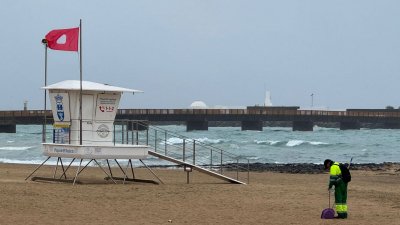
The beach of El Reducto, the main one in the capital of Lanzarote, multiplied by twelve the legal values allowed for coastal bathing waters last July. This area was closed to the public after a discharge point was detected in the Punta del Camello area and the bathing ban was confirmed by analyses carried out in the Punta del Camello area.
The sample taken on July 27, which led to the bathing ban for several days, showed a proportion of 6,300 colony-forming units (CFU) of Escherichia Coli per hundred milliliters of water analyzed. This is according to the results obtained by Public Health in the analyses carried out at one of the three bathing points on this beach.
The maximum value set in Spanish legislation to consider bathing waters to be of sufficient quality and suitable is a maximum of 500 CFU per hundred milliliters, that is, twelve times less than that recorded at the end of July in El Reducto.
In the analysis of the other value, the bacterium Enterococcus, this beach reached 390 CFU per hundred milliliters, while the maximum allowed value is 200. These values even exceeded those recorded in October 2025, when the bathing ban was decreed on the beach for six months due to high levels of fecal bacteria. At that time, E. Coli values reached 550 CFU per hundred milliliters and Enterococcus up to 430.
The island's capital, the most populated city in Lanzarote, registers the highest number of discharges recorded in the Censo de vertidos desde tierra al mar (Census of discharges from land to sea), updated last August. In total, seventeen sources discharge urban wastewater and other substances into the sea.
On this last occasion, the Arrecife City Council attributes this new fecal filtration in El Reducto to the aftermath of the rupture of the pumping network in Argana Alta, which would have generated overflow problems in one of the outlets at Punta de El Camello. Meanwhile, the closure for almost half a year of the beach from October 2025 was related to a discharge point located next to the beach.
What is E. Coli? And Enterococcus?
The contamination of bathing waters on the beaches of Lanzarote has made the bacteria E. Coli and Enterococcus two words frequently used to explain the temporary bathing ban on Lanzarote's beaches. But what are these bacteria really?
E. coli is a bacterium that is present in the distal intestine of warm-blooded organisms, both mammals and birds. It can reach seawater through discharges of urban wastewater, among other reasons. Enterococci are also bacteria that can cause infections and generate great resistance to antibiotics.
According to the World Health Organization (WHO), exposure to water contaminated by these bacteria can cause gastrointestinal problems, such as gastroenteritis, as well as infections. Furthermore, it is more noticeable in children, who may accidentally swallow the water, immunocompromised individuals, and the elderly.
Add La Voz de Lanzarote as a preferred Google source.
Stay informed with the latest current news.