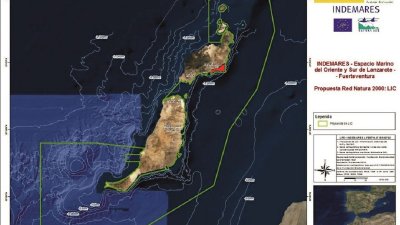
The marine environment of Lanzarote is "in danger", warns 'Ecologistas en Acción' and to protect it, they propose a set of proposals such as the 'Plan of the Protected Marine Space of Lanzarote'. It identifies geographical limits, projects, activities and uses that damage marine biodiversity, putting at risk the quality of the sea that surrounds us. There are several pressures that affect the conservation of the natural and cultural values of this space.
One of them is the 'Regional Plan for Aquaculture Management of the Canary Islands' (PROAC) for the development of this activity in front of Costa Teguise, in front of the capital and its entire Marina "endangering" the nature of the marine environment and the land strip that surrounds it, informs the confederation of environmental groups.
The mismanagement of the aquaculture cages of Playa Quemada, creating "bad odors and contaminating the waters with oils from the feed", the destruction of the seabed and the escape of non-native predatory species "altered the biological cycles" of the coasts near these cages. Now, it is intended to install 59 cages between Arrecife and Puerto del Carmen, where an economic, sports, leisure, maritime transport, among other activities, takes place.
Also the 'Plan for the Management of the Maritime Space' (POEM) proposes a "wide area for the development of marine energies on the eastern coast, coinciding and overlapping" with the LIC Lanzarote East-South and Fuerteventura.
The Ministry of Ecological Transition determined to place the marine wind farm at "1.8 km from the coast, from the beaches of Costa Teguise, without caring that the marine wind turbines", its installation process and its daily operation "alter life in marine ecosystems and cetaceans collide with their infrastructure".
In addition, this activity of large multinationals would affect the 'Zostera noltii Hornemann', an essential species for environmental balance and therefore included in the 'Catalog of Threatened Species of the Canary Islands'. But, in addition, we know that "38% of the marine biodiversity of the Canary Islands Archipelago is located in La Marina de Arrecife", an ecosystem in danger of conservation in which the aforementioned marine phanerogam survives.
We add the brine discharges, the changes in the dynamics of currents and water temperature, the increase of sediments, bottom trawling, the pots or the collision of boats with cetaceans, affects the insular sea. We do not forget that it is one of the most important cetacean passages between both islands and it is essential that the companies that work in the area know how to act.
To this we add the extraction of minerals and aggregates (rocks, rare earths, metallic minerals, gravel) from the seabed, the tests and oil explorations, the military operations and maneuvers in the marine environment, the passage of ships and commercial vessels that produce acoustic pollution and that affect the seabed affecting marine biodiversity; the cargo ships of enormous tonnage that dump harmful substances, the amount of waste that arrives to the coast of Alegranza, La Graciosa, Montaña Clara and the islets, and Lanzarote.
Finally, we point out the "desalination discharges", as the number of emissary points that exist is known and to which are added the numerous private desalination plants of large hotel companies that emit the brines from desalination directly into the sea.
For all this, we demand the revision and modification of the limits of this Protected Marine Space LIC to include all the marine waters, from the same insular coastal edge, without excluding the area between Costa Teguise and Puerto del Carmen, which inexplicably left out. It is the only way for the general interest to prevail over the particular and business interest.
Consequently, it is also necessary to "raise" before the Canary Islands Government the opportune correction of the 'Regional Plan for Aquaculture Management of the Canary Islands' for Lanzarote and its adaptation to the new reality with the entrance.


Add La Voz de Lanzarote as a preferred Google source.
Stay informed with the latest current news.