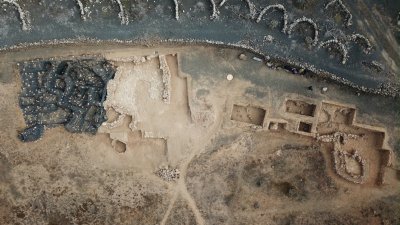
The archaeological excavation campaign developed during 2026 at the El Bebedero site, in Teguise, has brought to light a rich and varied heritage that provides new clues for the knowledge of the ancient history of Lanzarote and the Canary Islands.
The work was carried out from mid-July for four weeks and was financed by the Teguise City Council through a grant to the Canaria University Foundation of Las Palmas, the only Canarian institution that collaborates financially in this research.
The intervention, which continues the research initiated at the site in 1985, has been directed by Dr. Pablo Atoche Peña, Professor of Prehistory at the University of Las Palmas de Gran Canaria (ULPGC), leading a team composed of Mª Ángeles Ramírez, Pedro Méndez, Antonio Bueno, Julia Lecuona, Elena Hernández, Fany Talavera, Víctor Martínez, Claudio Moreno, and José Bueno.
The mayor of Teguise, Olivia Duque, highlighted "the enormous importance of continuing to support research that allows us to increasingly understand our origins and that is providing highly relevant information not only for Teguise and Lanzarote, but for the Canary Islands as a whole".
Duque pointed out that "El Bebedero is an example of the extraordinary historical and archaeological heritage that our municipality preserves and we have the responsibility to contribute to its research, protection, and dissemination". She also thanked the research team for their work over the decades and their contribution to the knowledge of the island's history.
An exceptional indigenous hydraulic infrastructure
Among the main results of the 2026 campaign is the completion of the excavation of the large paved area intended to capture and conduct rainwater to the cistern discovered in 2025.
The complex, also comprising decanters and pipelines, constitutes the first indigenous hydraulic infrastructure of this type and complexity recorded in the protohistory of the Canary Islands. Its use has been dated between the 1st century BC and the 4th century AD and demonstrates the high technical knowledge possessed by the indigenous community of Lanzarote to capture, conduct, and store rainwater.
The documentation of architectural elements belonging to two rooms located in previous campaigns has also been completed, and the deepest archaeological stratum of the site has been reached. In this level, bone remains of ovicaprids and fragments of handmade pottery have reappeared.
The research team has selected samples intended to determine with greater precision the antiquity of human presence in El Bebedero, probably located several centuries before the Common Era.
Five centuries of interaction with the Roman world
The findings obtained in El Bebedero, together with those known from the nearby settlement of Buenavista, continue to provide evidence of the interaction between the indigenous communities of Lanzarote and sailors and merchants from the Mediterranean cultures of Antiquity.
Among the recovered materials is a numerous collection of remains of domestic fauna, goats, sheep, pigs, and dogs, in addition to malacofauna, ichthyofauna, and avifauna, associated with different indigenous objects and imported elements.
The repertoire includes fragments of ceramic containers of diverse typology and functionality, from large containers to cooking vessels, some of the more recent ones decorated with incised, impressed, and relief motifs. Knives and other carved and polished lithic artifacts, stelae, grinding stones, bone awls, some of them hafted, elements of personal adornment, and metallic and vitreous objects have also been documented.
Of particular relevance are the numerous fragments corresponding to several types of Roman amphorae dated between the 2nd century BC and the 4th century AD, which are added to those found in previous campaigns, including an almost complete specimen found in 2022.
The archaeological complex reflects the presence in El Bebedero of a very active indigenous community that, for approximately five centuries, interacted with Roman people who landed in Lanzarote. Research points to possible exchanges of local products, probably water, dried meat, or domestic animal hides, in exchange for wine and oil transported in amphorae, as well as objects of copper, bronze, iron, and glass beads.
New technologies at the service of research
During the campaign, advanced technologies such as 3D laser scanning, digital photogrammetry, and drones have been employed, which have allowed for the daily acquisition of detailed images of the site and continuous recording of the progress of the work.
These procedures facilitate rapid and precise documentation of findings and allow for a more detailed understanding of the different constructive structures present at El Bebedero, offering new perspectives on the organization and functionality of the settlement.
In parallel, a comprehensive study is being conducted for the identification and cataloging of all recovered archaeological materials, with the participation of specialists in archaeology, biology, paleontology, and archaeometry. This interdisciplinary approach allows for a deeper understanding of both the site and its connections with other archaeological sites in Lanzarote and the Roman world.
The councilor for Archive and Historical Heritage of the Teguise City Council, Mar Boronat, stated that "each new campaign confirms the enormous scientific potential of El Bebedero and the importance of maintaining continuous research that allows us to adequately document, conserve, and understand everything this site is revealing to us."
Boronat also highlighted that "these discoveries help us better understand how the first communities of Lanzarote lived, how they organized themselves, and what relationships they maintained with those who arrived on the island from other territories." The councilor also emphasized the importance of bringing the results of the research closer to the citizens to promote knowledge, appreciation, and protection of historical heritage.
A fundamental enclave for understanding the origins of the Canary Islands
The results of the 2026 campaign reinforce the scientific importance of El Bebedero and the nearby Buenavista site for reconstructing the ancient history of Lanzarote and the Canary Islands. The research, initiated in 1985, continues to provide fundamental information about the first communities that inhabited the island, their adaptation to the territory, and their relationships with the Mediterranean cultures of Antiquity. During this campaign, the site also received various visits organized by the Historical Archive of Teguise and the Pueblo Maho Cultural Association.
Add La Voz de Lanzarote as a preferred Google source.
Stay informed with the latest current news.