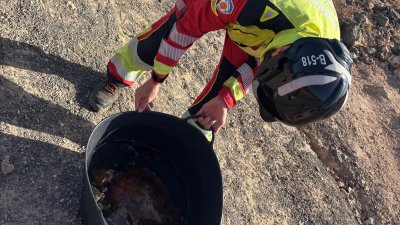
Firefighters rescued another injured sea turtle in the Los Ancones area on Tuesday afternoon, in the municipality of Teguise, according to the Security and Emergency Consortium.
Around 5:10 PM, a private citizen alerted emergency services to the presence of an injured sea turtle in the Los Ancones area, so they quickly headed to the location in an R-4 vehicle.
Upon arrival, they located a sea turtle specimen with several apparent injuries, so they immobilized and collected it, applying the necessary measures to ensure its integrity during handling and transport.
Afterwards, the specimen was transferred to the Fire Department facilities, where it remained in custody awaiting intervention by the competent Environment personnel, responsible for its collection and transfer to the corresponding wildlife recovery center.
This is the third sea turtle rescued since last July. The first was rescued by the crew of a boat during a regatta, as it was entangled in plastic and fishing lines. For their part, the second was found by a group of people from a recreational boat. In this case, they cut the ropes that immobilized it and released it into the sea.
What to do when finding an injured or trapped species
The Environment Area of the Cabildo of Lanzarote and the Marine Fauna Observation Network establish a clear protocol for rescuing turtles trapped in plastic, nets, or raffia.
The first step is to notify and call 112 or the Injured Wildlife Collection Service of the Cabildo of Lanzarote (696 733 177). After that, the location of the animal and its condition must be reported so that Environment Agents can go to the scene.
However, the protocol states that the animal should not be released or completely untangled, as doing so hastily can cause hemodynamic shock or toxic necrosis if the cut circulation returns suddenly to the bloodstream.
Furthermore, one should not pull on any ropes, fishing lines, or hooks that the animal may have swallowed, as it can cause tears.
While waiting for rescue, the animal should be kept in the shade and its shell covered with a damp towel without covering its eyes or nostrils. Thus, the animal should not be fed or given water.
Add La Voz de Lanzarote as a preferred Google source.
Stay informed with the latest current news.