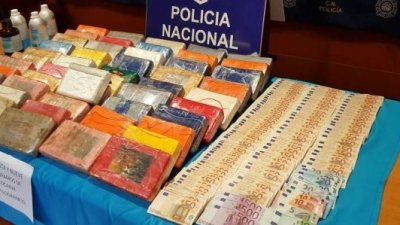
Agents of the National Police have arrested eleven people in the Canary Islands archipelago as part of Operation Escipión, and have managed to dismantle a criminal organization dedicated to drug trafficking. The detainees had managed to establish a constant and regular flow of cocaine imports from South America to the islands, where part of the drug was distributed while the remainder was sent to different European countries. To avoid being detected by the Police, the members of the network used a telecommunications company, using their own network of encrypted communications. In the searches carried out, the agents seized 49 kilograms of cocaine, 20 kilograms of hashish, a modified pistol and ammunition, substances for adulterating and manufacturing the drug, and 39,460 euros in cash.
49 kilos of cocaine transported on a cruise ship
The operation began at the end of last year around an international organization, led by citizens from territories of the former Yugoslavia, dedicated to the distribution of cocaine. The components of the gang formed a key piece of a criminal network that operated internationally and extended through the Peninsula and other countries in northern and eastern Europe, such as Russia.
The organization used various methods to introduce the drug into national territory. On this occasion, the cocaine arrived aboard a cruise ship from Rio de Janeiro, where it was allegedly loaded, with the collaboration of one of the crew members in the engine room. The unloading took place at a stopover on the island of Lanzarote to be hidden in a hotel room in the municipality of Tías. In that place, the 49 kilos of cocaine were seized while being guarded by two members of the organization.
Military training in Eastern European countries
The working methods of the drug traffickers derived from the training of their members as soldiers in Eastern European countries. The leader of this branch of the organization, known to all as "The Professor," had served in the Yugoslav National Army. In addition, he was currently a fugitive from German justice, pending a 14-year sentence.
The detainees adopted security measures both in their movements, which made their surveillance and monitoring difficult, and in their communications, thanks to an encryption system. One of the investigated was carrying seven phones turned on and operational at the time of his arrest.
During the time that the investigation lasted, it was verified that the members of the organization traveled very frequently to Madrid and Barcelona as well as to other European capitals. In addition, they received visits from citizens of Eastern European countries, most of them investigated by the Police of their countries of origin, who stayed in exclusive villas.
"Human couriers" for transporting money
The investigations concluded that said organization transported the profits from the sale of the drug in national territory through human couriers who took the cash out of our country in 500€ and 200€ bills. These had been obtained by the "smurfing" method, for which they had the active and indispensable collaboration of several bank employees, who, upon payment of a commission and with knowledge of the illegality of their actions, reserved in their respective branches bills of great face value that they delivered to the criminal organization, accepting small bills in return. This facilitated the concealment, handling and transport of large amounts of cash.
Among those arrested are an Italian, a Norwegian, a Croatian, a Serbian, a Montenegrin, a Bosnian-Herzegovinian, a stateless person of Swiss origin and 4 Spaniards. Likewise, the organization used several national traffickers, based on the island, to distribute the drug in the Canary archipelago.
In the 6 searches carried out, the agents seized 49 kilograms of cocaine, 20 kilograms of hashish, substances for adulterating and manufacturing the drug, and 39,460 euros. Numerous false documents from Slovenia were also seized - which they used in Spain - as well as a modified pistol suitable for firing and several 6.25 mm cartridges.
The investigation and dismantling of the aforementioned criminal organization was carried out by officials attached to Group IV of UDYCO of the Provincial Brigade of Judicial Police of Las Palmas, collaborating in the arrest the Special Operational Security Group of the Superior Headquarters of Police of the Canary Islands
Add La Voz de Lanzarote as a preferred Google source.
Stay informed with the latest current news.