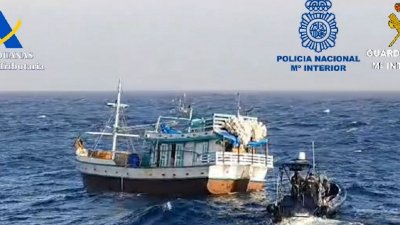
The National Police in a joint operation with the Civil Guard and the Customs Surveillance Service of the Tax Agency has intercepted a Brazilian fishing vessel, named 'Ephesians 5-20', about 150 miles from the Canary Islands, which was carrying more than 1,500 kilos of cocaine divided into 60 bundles, according to initial estimates.
The boarding by the 'Cóndor' patrol boat of Customs Surveillance, on which agents of the National Police and the Civil Guard were embarked, was carried out in a context of "harsh weather conditions", the National Police reported in a statement. In the course of the operation, the six crew members of the fishing vessel were arrested, five of Brazilian nationality, including its captain, and one of Venezuelan nationality.
The narcotic substance was in a compartment "specially built in the engine room of the fishing vessel for its concealment", and to hinder its discovery in the course of a possible inspection of the vessel. The choice of the engine room is not accidental on the part of criminal groups, given the working conditions in it, due to the noise of the machine and the high temperatures.
The operation, the result of international collaboration through the Maritime Analysis and Operations Centre - Narcotics (MAOC) and coordinated by the Intelligence Center against Terrorism and Organized Crime (CITCO), was carried out under very adverse conditions due to the existence of a force 7 storm and strong winds.
In addition to the weather conditions, there is the difficulty of sailing back to port with a fishing vessel in poor condition, with a leak in the engine area, and whose engines stopped in the middle of the night.
The operation culminates today with the arrival of the ship to the port of Las Palmas, for the unloading of the drug and making the detainees available to the courts by Customs Surveillance, National Police and Civil Guard.
Atlantic route
This operation is "one more of those carried out in the fight against drug trafficking in the so-called 'Atlantic cocaine route', known to be used by fishing vessels that, coming from South America, transship narcotic substances in the middle of the Atlantic for their subsequent introduction into the European continent.
On this occasion, the researchers' attention has been drawn to the fact that the small fishing vessel was so close to the Spanish coast, since normally the transshipments take place at a greater distance.
The success of this type of action is the result of the excellent collaborative work between various European and national organizations (MAOC, CITCO) and the different police and customs forces, as well as, in this case, the cooperation of the Brazilian authorities.


Add La Voz de Lanzarote as a preferred Google source.
Stay informed with the latest current news.