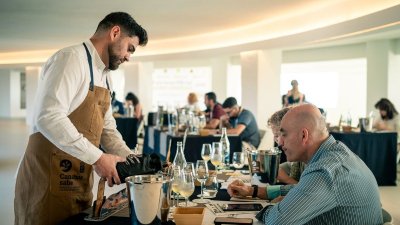
A total of 230 wines from 60 wineries are participating in the Agrocanarias Official Wine Competition, organized by the Canary Islands Institute of Agri-Food Quality (ICCA), to distinguish the best wine productions with Protected Designation of Origin (PDO) produced and bottled in the archipelago.
The event, which this time is held in Los Jameos del Agua, in Lanzarote, for three days, has seen an increase in participation with 52 more productions (more than 29.21%) than in the previous call. There are samples from all the islands distributed in 161 from Tenerife, twenty-three from La Palma, sixteen from Lanzarote, ten from Gran Canaria, eight corresponding to El Hierro, seven from La Gomera and five from Fuerteventura.
In addition, the competition has twelve different categories based on the type of grape and the method of production. These include young dry whites or barrel-fermented whites (87), young reds/barrel-aged reds (68), semi-dry (seven), semi-sweet (31), sweet (eight), sweet malvasias (four), dry rosés (thirteen), tea (one), sparkling wines (four) and aged wines (seven). All these productions correspond, according to the rules of the competition, to the 2022 or 2023 harvest, except for aged wines, teas, sweet wines, sparkling wines and sweet malvasias.
This edition represents the eleven PDOs of the archipelago: Abona (with 54 samples from six wineries), Canary Islands (with 52 wines from fifteen companies), Tacoronte-Acentejo (with 34 products from eight wineries), La Palma (with twenty-three samples from seven companies), Valle de Güímar (with twenty-one wines from five companies), Lanzarote (with sixteen productions from eight wineries), Gran Canaria (with ten samples from five wineries), El Hierro (with eight wine productions from three producers), La Gomera (with seven samples from four wineries), Valle de La Orotava (with three wines from two wineries) and Ycoden-Daute-Isora (with two products from a single winery).
The Councilor of the Area, Narvay Quintero, valued the effort of the Canary Islands wine sector for its "transcendental change" in recent years and the "continuous increase in the quality" of the wines. He also highlighted the importance of the link between the primary sector and tourism, highlighting the 'Growing Together' project that seeks synergies between both sectors to turn local agri-food products into tourist assets. In addition, he indicated that "citizens should contribute to the sector by consuming local products and promoting a circular economy".
The director of the ICCA, Luis Arráez Guadalupe, said he was "very satisfied" with the number of wines participating in the competition, "which represents a significant increase compared to previous editions." "This positive response reflects the confidence that wineries place in this event as a powerful platform to give visibility and promote their products in order to encourage commercialization," he added. He also positively valued the active participation of all the Regulatory Councils of PDO wines of the Archipelago in this call, as well as the financial support of the Cabildo of Lanzarote and the Art, Culture and Tourism Centers (CACT) of the island.
For his part, the member of the jury of the contest Diop Diouf Sega pointed out that "the Canary Islands is one of the regions where wine reflects its origin, through regenerative practices, such as biodynamic, ecological cultivation and small producers." In this context, he celebrated that "a contest with quality Canarian wines is developed that achieve international recognition thanks to their typicality and their uniqueness".
In addition, in statements to the media, he shared that he arrived to the islands from Senegal when he was nine years old, and decided to train in this field at the Basque Culinary Center (Donostia - San Sebastián). He is currently the owner of two restaurants in Madrid and a specialist in the analysis of agri-food products.
Among other authorities, the president of the Island Council, Oswaldo Betancort, the mayor of the City Council of Haría, Alfredo Villalba, and the first deputy mayor, Chaxiraxi Niz, participated in the opening of the contest.
The island president stressed that "agricultural and industrial activity in Lanzarote is an essential part of our culture and history, especially in La Geria, where the unique landscape has been shaped by the work of farmers." He also pointed out that "the wineries are structural elements for the maintenance of the landscape, always putting the defense of the traditional winegrower as the basis of the development of the area".
The contest is governed by a system of blind tasting, so that a panel of twenty-two specialist tasters in the analysis of agri-food products evaluates the samples of the contest without knowing their origin, and determine with their assessments the productions that are awarded with the Grand Gold Medals, Gold Medals and Silver Medals, as well as the special distinctions of Best Wine of the Canary Islands, Best Wine Chosen by the Winemakers of the Canary Islands, Best Image and Presentation, and Best Organic Wine of the Canary Islands 2024, which will be revealed in an act in which the jury's decision will be read, which will be held in the coming weeks.
The awarded wines may use for one year the official distinctive corresponding to the prize received (a kind of adhesive medal that is placed on the bottles) and participate in the different events of promotion and promotion of the Canarian products that the ICCA organizes throughout the year in the Canary Islands and outside our territory.
Finally, the ICCA will cover the registration and logistics costs corresponding to the participation in the annual competition of the CERVIM (Center for Research, Studies, Protection, Coordination and Valorization of Mountain Viticulture) of those wineries that have been admitted to the Agrocanarias Competition. Likewise, they will be entitled to the payment of the logistics costs corresponding to the participation in the national wine competition that is determined in the Council of Vine and Wine.
During the days of this Wednesday and Thursday, the preliminary and final phases are developed, while on Friday, in which a panel composed of twelve winemakers from the islands, one for each PDO and another for the Association of Winemakers of the Canary Islands, will decide the best wine of winemakers following the criteria established in the rules.
Add La Voz de Lanzarote as a preferred Google source.
Stay informed with the latest current news.