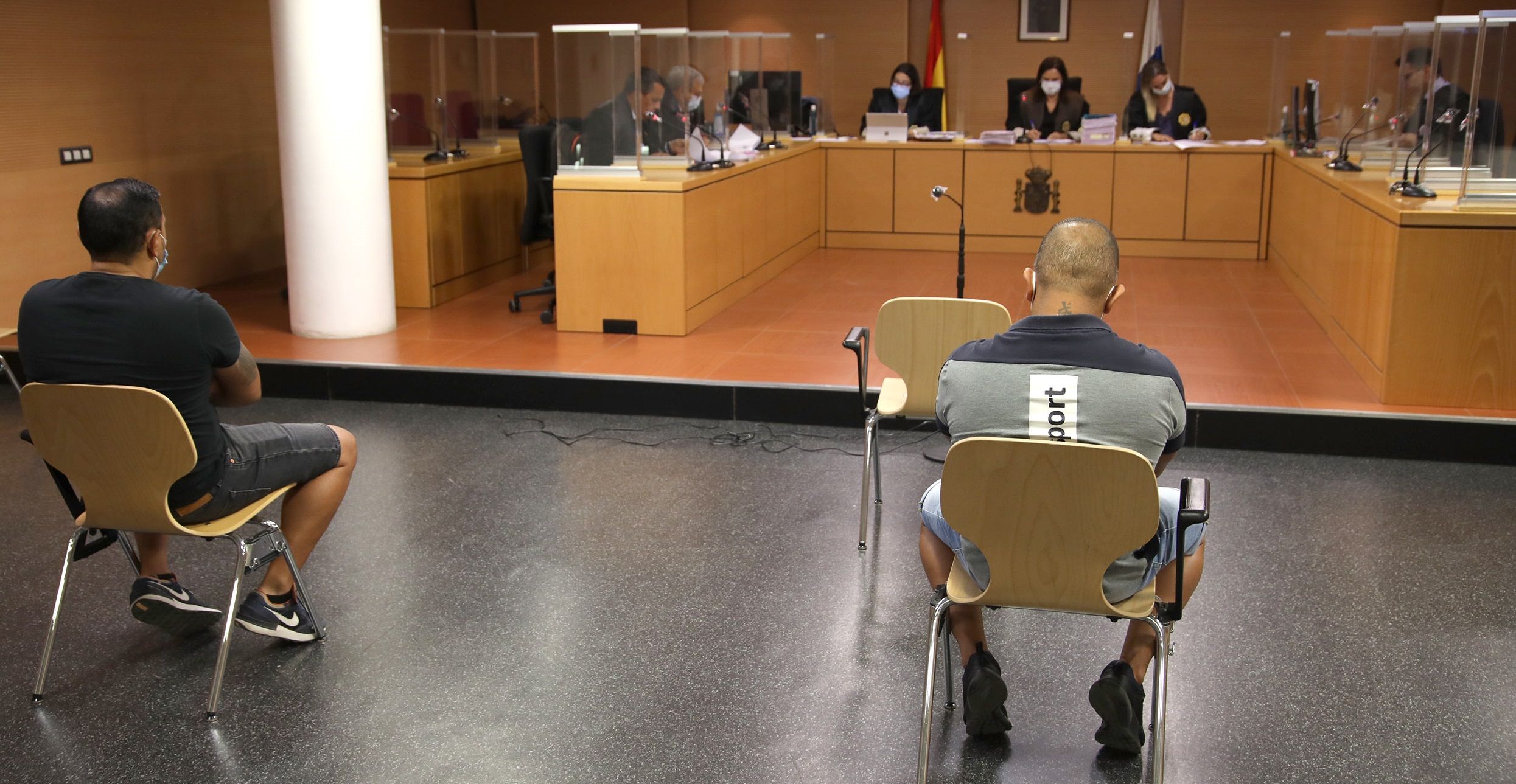
Five years ago, during routine checks in parks and drug consumption points in Arrecife, agents from the Citizen Security and Intervention Unit (USCI) of the Local Police began to detect something: a type of wrapping for marijuana and hashish that was frequently repeated.
“They told us they acquired them at the association”, one of the agents stated this Tuesday, during the trial against those responsible for “El Tabaquito Terapéutico”. In theory, the association was a cannabis club, where it is only allowed to consume marijuana inside the premises and to a “closed group” of people. However, drugs allegedly sold there were being detected on the street.
“A device was set up to confirm if the facts were real”, explained one of the members of the USCI. For this, two agents initiated a “discreet surveillance”. “We were in a camouflaged vehicle, watching the entrance to the premises”, one of those police officers recounted.
There they saw vehicles parking next to the establishment, from which a person got out, entered the premises, and “after a few minutes” came out again and got into the car.
As part of the device, another ordinary patrol was activated. “I was in a marked vehicle, waiting for my colleagues to notify us”, another one said. When someone left the premises, they received a call indicating the vehicle's details and “a little further ahead they were stopped”.
“They came out with substances and admitted they had bought them there”, confirmed five of the Local Police agents who intervened in that operation. Furthermore, the marijuana and hashish were “in the same wrapping” that had been detected in the routine checks at drug consumption points.
Drugs “hidden behind a painting”
As a result of that surveillance, they prepared a report and sent it to the National Police, who continued the operation. “We worked several times with the USCI group of the Local Police”, explained one of the national police officers who also testified in the trial, and detailed that they sometimes act in a coordinated manner between both bodies due to the lack of personnel.
In his case, he requested the judicial order to access the premises and participated in the entry and search. Inside, they found the two defendants, Octavio Alexander S.R. and Luis Fernando R.M., who were arrested after finding in the establishment more than 4 and a half kilos of marijuana, 108 grams of hashish, and other cannabis derivatives.
Both this police officer and another agent who intervened in the search explained that part of the drugs were found “hidden behind a painting”. In that hole in the wall, according to their statement, “there was a loft with more substances”.
Disparate testimonies among eight “members” of the club
During the trial, eight “members” of El Tabaquito Terapéutico also testified, that is, people who paid an access fee and then went to the premises to get the drugs. In total, the association had 430 registered members.
“It was a very bad time in my life”, “my wife had died and I went sometimes to relax”, “I had a minor son, that's why I didn't smoke at home”, one of them declared, quoted by the defense. In his case, he assured that he only “smoked inside the association, not on the street”, although he did not remember how much he paid for the substances.
Six other witnesses had been summoned by the Prosecutor's Office, as they were all intercepted on the street with drugs, during the police surveillance operation at the doors of the premises.
“Normally I had always smoked inside. It was the first time I took it out and the first time I was caught”, another one declared, in a story in which several agreed, assuring that just the day the agents were there, it was the first time they had taken drugs out of the establishment.
However, others did confirm that they did it regularly. “I grabbed five euros, made a joint there and took another one to my house”, said one of them, who upon finishing his statement did not hide his discomfort at being made to “waste a day for these things”. In his case, he didn't even remember being stopped by the police, although he did acknowledge that they gave him marijuana “in exchange for money” at the premises.
What almost none of them could remember either is how much they paid for that supposed entry fee to the association, and they differed on whether or not there was an annual fee afterward. In any case, none of them could specify its amount. According to the defense, it was not a “business” of selling, and those fees were what gave them access to marijuana in the association.
However, almost all the witnesses agreed that on each visit they paid for the drugs they acquired, although almost none of them could specify the price either. “I don't know. In those years I was kind of wasting time and I have no idea”, one of them declared.
Another one stated that he had been stopped “several times by the police” and that on that occasion he was carrying hashish and “had bought it at the club”. Regarding how he knew the “association”, he stated that he “found it on the Internet”, which for the Prosecutor's Office is a prohibited "advertisement" in a cannabis club.
“Sometimes I smoked there, but normally I went to my house”, he added to questions from the prosecutor. In this regard, the defenses maintained that the members were warned that they could only consume inside the premises, but that some “betrayed” the trust of the defendants. “I couldn't put a policeman at the door”, one of them declared in his last turn to speak.
During the trial, there were also scenes of confusion among the witnesses. “Were you a consumer because of the accident you had?”, a defense lawyer asked one of them. “Accident? What accident?”, he responded surprised.
Of the eight members of El Tabaquito Terapéutico who testified as witnesses, one stated that he consumed because he was going through a difficult personal situation and two others alleged medical issues -one of them that she was an alcoholic and to overcome that addiction she resorted to marijuana-, but the other five did not mention any reasons.
In his conclusions, the prosecutor maintained that the association did not comply with any of the purposes stated in its statutes, and that its “only activity” was to “sell drugs indiscriminately”, without authorization and without complying with the requirements demanded of a cannabis club.
Add La Voz de Lanzarote as a preferred Google source.
Stay informed with the latest current news.