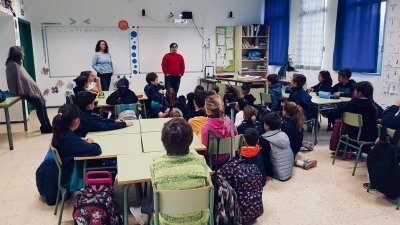
The Ministry of Education, Vocational Training, Physical Activity and Sports of the Government of the Canary Islands, led by Poli Suárez, in collaboration with the Canary Academy of the Language, has made public the jury's decision for the fifth edition of the school competition My Favorite Canarianism, an initiative that promotes among the student body the knowledge, appreciation, and use of the linguistic heritage of the Canary Islands through proposals developed in schools.
Specifically, the decision has recognized the CEIP Doctor Alfonso Spínola, from Lanzarote, for alegar, in the second and third cycle of Primary Education category.
In the rest of the Canary Islands, the Tarajalejo Infant and Primary Education Center (CEIP), from Fuerteventura, was awarded for the Canarianism jarea, in the Infant Education and first cycle of Primary Education category; the CEIP Los Alisios, from Gran Canaria, for balde, in the Special Education and Enclave Classrooms category; and the Institute of Secondary Education (IES) Profesor Juan Pulido Castro, also from Gran Canaria, for magua, in the Compulsory Secondary Education and Basic Vocational Training category.
The jury was composed of Humberto Hernández, a member of the Canary Academy of the Language; Carmen Elena Rodríguez and Carlos Antonio Casanova, technical coordinators of the Canary Natural, Social, and Cultural Heritage Area of the Educational Innovation Service of the Ministry of Education; and Jesica Fortes Regalado, technical coordinator of the Communication-Reading Program, Libraries, and School Radio Area of the same service.
Participants create creative videos focused on a Canarianism, researching its meaning, origin, and use, with the support of reference tools such as LexiCán and the Basic Dictionary of Canarianisms. In this way, the project favors the development of communicative competence, reinforces the linguistic confidence of the students, highlights the value of Canarian Spanish, and contributes to combating stereotypes and prejudices about dialectal varieties, understood as a demonstration of the language's cultural richness.
The competition, driven by the Directorate General of Planning, Inclusion and Innovation, coordinated by David Pablos, aims to encourage classroom practices among teachers that integrate the linguistic and cultural heritage of the archipelago, contributing to students knowing, appreciating, and respecting the most relevant aspects of the Canarian dialect. Likewise, the initiative connects directly with the educational curriculum of the Canary Islands, which contemplates the development of attitudes of respect, protection, and conservation of the cultural, historical, natural, social, and linguistic heritage of the islands.
The distinguished Canarianisms reflect the richness and uniqueness of the speech of the Canary Islands. Thus, jarea designates fish that has been opened and salted and is subsequently dried in the sun; alegar means to converse, either for entertainment or to comment on the actions of an absent person, and also to protest or argue about something; balde names the container in the shape of an inverted truncated cone, provided with one or two handles, used to transport or contain liquids or other materials; and magua expresses a feeling of sadness or distress caused by the loss or longing for something, or by not having performed an action that would have been beneficial.

Add La Voz de Lanzarote as a preferred Google source.
Stay informed with the latest current news.