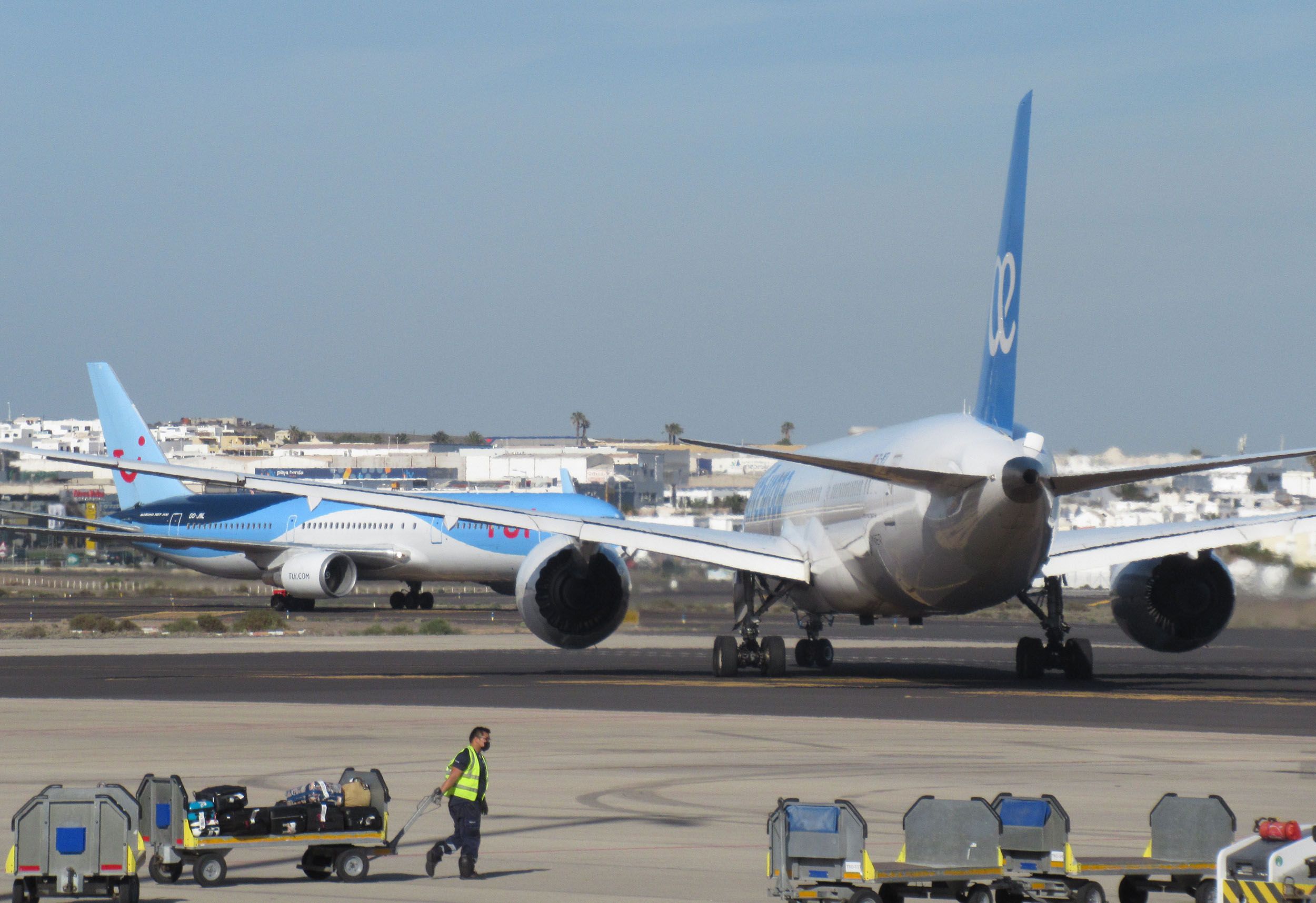
The Airline Association (ALA) foresees that passenger traffic will fully recover and reach pre-pandemic levels in 2023, after observing a clear upward trend in recent months and with a summer in which it is expected to reach figures very close to those recorded in 2019.
This was announced by the president of the employers' association, Javier Gándara, who acknowledged that his expectations contrast with those handled by the Spanish airport manager (Aena), which projected the 100% recovery of air traffic from 2025.
Their data indicate that for this summer season the number of scheduled seats is practically the same as before covid-19 (about 212 million seats compared to 213 million in 2019), although he recalled that this indicator may vary as the activity evolves.
"There is a great heterogeneity at the regional level," said Gándara, who cited as an example of positive cases those of the Canary Islands and the Balearic Islands, with 8.1% and 10.6% more seats scheduled for this summer than for that of 2019, while in Madrid and Barcelona the figure is 7.5% and 11% lower, respectively.
As for occupancy -that is, the percentage of tickets sold with respect to the total capacity of the plane-, the employers' association estimates that in 2022 it will be around 74%, 11 points away from the 85% that Spain presented on average before the pandemic.
Occupancy stood at 65% in 2020 and 70% in 2021, according to Gándara, who revealed that after the slump in January due to the ómicron variant, the indicator stood at 78% in both February and March.
Regarding Easter Week, their estimates indicate that between 80 and 85% of the passengers who did so before covid flew. "We must bear in mind that we are comparing ourselves with a year (2019, the last before the pandemic) that was a record in tourism," insisted the president of ALA, who was also confident that Spain may be one of the countries that recovers pre-covid levels more quickly on a global scale due to the type of structure of its air traffic.
Specifically, he recalled that around 80% of traffic corresponds to short- and medium-haul flights and between 80 and 90% of passengers travel for vacations or family visits, while recovery is slower in business tourism and long-haul connections.
International flights grow
Companies are also detecting a recovery of international connections, with levels of 75% compared to 2019 in this start of the year, and national connections continue to be stabilized above 80%.
Among the challenges, the employers' association has warned of the risk of long queues and waits in the summer in the passport control area, and has urged the Government to reinforce these points in airports with more international flights.
In this regard, he regretted that in Barajas alone it is estimated that 3,000 passengers lost some of their connections during Easter Week due to this reason.
Another concern of the sector is the management of air traffic and flight delays, especially in view of this summer. "80% of air traffic management delays affecting Spain occur outside the country, especially in France. This year there is a system change in Reims that will force traffic to be diverted to the Marseille center, which is already problematic in itself," warned Gándara, who also stressed that the communities most at risk of being harmed by this reason are Catalonia and the Balearic Islands.
The association that groups the airlines has also warned about the sharp rise in the price of kerosene in recent months, which has doubled compared to 2021, and which threatens to cause an increase in ticket prices, although more in the medium and long term.
"Fuel accounts for about 30% of the costs of companies. Some have hedges, insurance that protects them from price variations, and are less exposed, but if the situation continues over time it will end up affecting fares," Gándara warned.
Add La Voz de Lanzarote as a preferred Google source.
Stay informed with the latest current news.