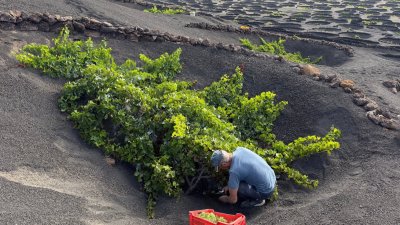
The Designation of Origin Wines of Lanzarote faces the final stretch of the 2026 harvest "with optimism and the satisfaction of seeing that the effort made throughout the year is beginning to be reflected both in the vineyard and in the wineries".
Although the campaign has not yet concluded, forecasts indicate a harvest that "could exceed three million kilos of grapes", especially hopeful news after two harvests marked by lower-than-expected production.
Beyond the figures, the Regulatory Council highlights the excellent condition of the grapes and the quality that this harvest is offering, aspects that allow for enthusiastic anticipation of the elaboration of the wines of this vintage. A scenario that provides a boost for grape growers and winemakers, the main protagonists of a sector that continues to demonstrate its ability to adapt and continue growing without losing sight of excellence.
This context also serves to take stock of a particularly intense 2026 for the Designation of Origin, a year in which training, promotion, and support for the sector have once again been among the main lines of work of the Regulatory Council.
Training to face vineyard challenges
With the aim of continuing to strengthen the sector's knowledge, a viticulture training program was developed, taught by renowned technicians Julio Prieto and Emilio Peiró. A course conceived from an eminently practical approach, in which theory found its continuation directly on the ground.
Throughout different training modules, grape growers and sector professionals were able to delve into aspects such as respect pruning, identification and management of pests and diseases, efficient irrigation management, or green pruning. The practical sessions were held on farms on the island, allowing for the analysis of the real evolution of the vines and the on-site verification of the results of the different techniques applied during the vegetative cycle.
The training continued with another of the year's major initiatives, led by oenologist Xabier Kamio, focusing on one of the most representative varieties of the archipelago: Listán Negro.
For two days, attendees were able to gain in-depth knowledge of the singularities of this variety cultivated both in the Canary Islands and in Lanzarote, understanding how the characteristics of the territory, the different climates, and the distinct elaboration techniques allow for wines with very diverse profiles to be obtained without losing their identity. The tasting included everything from young reds and aged wines to rosés, sparkling wines, and Blanc de Noirs, highlighting the enormous versatility and personality offered by this variety.
Bringing the landscape and wine closer to the public
The calendar of activities once again focused on experiences that allowed for the discovery of Lanzarote's wine heritage from different perspectives.
Throughout this year, three interpreted hiking routes were held, covering some of the island's most representative landscapes. Hikers were able to learn firsthand about the work carried out in the vineyards, understanding the effort involved in cultivating vines on rofe and facing the island's unique climatic conditions. At the end of each route, everything learned made sense through the tasting of wines from participating wineries. In this edition, the routes featured Bodega Erupción, Rocanegra, and Tao Viticultores.
Gastronomy once again played an important role with a new edition of the Enogastronomic Experience, organized in collaboration with the Centers of Art, Culture, and Tourism of Lanzarote. The Cactus Garden hosted an evening where four wines from the Designation of Origin were paired with a carefully selected range of some of the most representative dishes from its restaurant's menu, a proposal that highlighted the perfect harmony between Lanzarote wines and cuisine that enhances the island's products and flavors.
During the summer, one of the most anticipated events by the public returned: "Once Upon a Vine, stories paired with our wines." On this occasion, Lanzarote narrator Isabel Cabrera led attendees on an emotional journey to Lanzarote in the first half of the 20th century from Bodegas El Grifo, the oldest winery in the Canary Islands.
Stories full of humor, memories, curiosities, and traditions allowed attendees to relive the way of life of past generations while discovering different wines from the winery, accompanied by a snack made with products so closely linked to the island's identity.
Constant work in service of the sector
Beyond awareness and promotional activities, the Regulatory Council continues to carry out permanent work to support the wine sector.
Among its functions, the control and certification of quality of wines protected by the Designation of Origin stands out, as well as continuous advice to winegrowers and wineries in the management of aid, subsidies and different administrative procedures that contribute to strengthening the sector's competitiveness.
Added to this is the intense promotional work carried out both within and outside Lanzarote to continue positioning the island's wines in new markets and consolidating the recognition of productions that, year after year, continue to receive the support of consumers and professionals.
In the area of vineyard protection, last June a new project, promoted together with the Cabildo de Lanzarote, also began to reinforce the inspection, surveillance, and monitoring of phylloxera. This initiative, with a planned duration of one year, will allow for intensified observation of the island's vineyards with the aim of detecting and acting as quickly as possible on any possible focus of infection, thus reinforcing the protection of one of the island's main agricultural assets.
The focus is on Malvasia Week
With the grape harvest now in its final weeks and a very positive balance of the activity carried out throughout the year, the Designation of Origin Vinos de Lanzarote is already working on its next major event with the public.
From November 3 to 8, the twelfth edition of Malvasia Week will be held, an already consolidated event that will once again make Lanzarote wines the main players in a program that will combine culture, gastronomy, tradition, leisure, and experiences around one of the island's most representative products.
A new opportunity to continue bringing wine closer to the public and to continue highlighting the work of a sector that, thanks to the commitment of winegrowers, winemakers, and institutions, keeps one of the world's most unique agricultural landscapes alive and projects, through each bottle, the identity of Lanzarote.
All information from the Regulatory Council of the DO Vinos de Lanzarote, at dolanzarote.com.
Add La Voz de Lanzarote as a preferred Google source.
Stay informed with the latest current news.