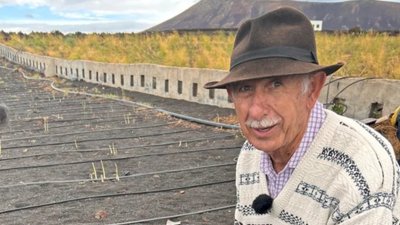
Manuel Peláez was born in the countryside, in the Cordoban valley of Los Pedroches, and after many years working in hospitality on the peninsula and in the Canary Islands, he decided to open an agricultural business in Lanzarote, Finca Tres Peñas, which today produces a wide variety of organic fruits and vegetables.
The agricultural entrepreneur, who participates in Ecocomedores, the program for children in the Canary Islands to eat fresh, local products, which has inspired other regions of the country, reviews his career and analyzes the situation of the sector on the island in an interview with the program Más de Uno Gourmet on Radio Lanzarote-Onda Cero.
- Where are you from?
I was born in the countryside. I am from the mountains of Cordoba. From a totally natural and quite rugged place, the Valle de los Pedroches, near Villaviciosa. When I was born, you couldn't travel by car there, nor by motorcycle or bicycle, only on horseback, mule, or donkey.
- How did you get into hospitality?
At 17, I went to work on the construction of a hotel in Begur, on the Costa Brava. When we finished, the boss asked me if I wanted to stay to work in the hotel's hospitality, and I stayed, I was there for six years.
- How did the connection with the Canary Islands arise?
On the Costa Brava, I met several Canary Islander colleagues who worked at the Hotel Santa Catalina and in the summer they worked the season there. At that time, there was no summer tourism in the Canary Islands. So I came to do the winter season in Gran Canaria.
I worked for companies for 15 years and then I started working for myself with a restaurant.
How do we explain to the young people of Lanzarote that it is possible to live from agriculture if water does not reach their plot?
- And your arrival in Lanzarote?
First I returned to Cordoba, I set up several restaurants, a hostel, a cooperative, but it didn't work out. So I returned to the Canary Islands, this time to Lanzarote, I had a friend in Haría, who had been a cook in one of my restaurants in Cordoba.
- How did you return to the agricultural sector in Lanzarote?
I have always been connected to the land even though I had businesses. The land never left my memory. It is the place where production happens and that product gives you life.
I bought Finca Tres Peñas a year after arriving in Lanzarote. I started growing fruits and vegetables and also raising animals. I closed the restaurant and decided to focus on organic agriculture and livestock farming. It's what I always wanted to do.
- Didn't anyone tell you that you earn more in hospitality than in agriculture?
Yes, some told me that I wasn't right in the head for dedicating myself fully to the field because "it doesn't make money".
It didn't seem so defined to me because I understood that the field should also make money, but you have to work at it. It's not just planting and harvesting, it's also selling. I started selling directly at street markets. For 11 years now, we have also collaborated with the Ecocomedores project, for local organic products, which has given us greater visibility, there are already 200 schools.
- How is that transmitted to new generations?
Children must be taught where an onion comes from, where an egg comes from, that they know the essence and harmony of the field.
We have had projects from the Cabildo de Lanzarote with children in the field, who were left with their mouths open when I ate a raw asparagus. There is always a girl or a boy who says: "Can you eat that?" They try it and always want more.
- How long have you been with Tes Peñas and how has the business evolved since its beginnings?
Since 2000. The farm has been growing. We have been introducing products besides onions, potatoes, and pumpkins. To sustain an agricultural company in Lanzarote, you have to diversify products, we produce all kinds of fruits and vegetables. Here I bring some from the season: grapes, pitaya, lettuce, cilantro, parsley, beetroot, milk figs... I haven't known any plant that doesn't bear fruit in Lanzarote, it's a grateful, blessed land.
- And the water problem?
Those of us who dedicate ourselves to the field in Lanzarote need water. How do we explain to the young people of Lanzarote that you can live from agriculture if water doesn't reach their plot? We have means to get optimal water for planting, for drinking, for everything. We cannot use water of dubious quality. Recycled water should not be for agriculture, but for other purposes such as parks and gardens.
- Where can we find your products?
In the street markets of each municipality or online, we have seasonal baskets or personalized baskets.

Add La Voz de Lanzarote as a preferred Google source.
Stay informed with the latest current news.