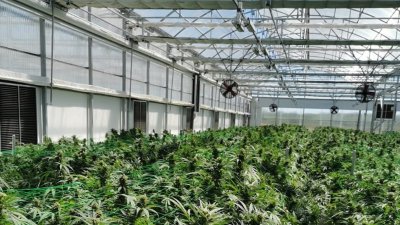
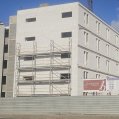
In the surroundings of the Nivaria Tech facilities in Tenerife, the remains of an agricultural past can be seen, of which only some abandoned greenhouses remain; however, a few meters away, a recently constructed building hides an industrial project that includes the first authorized medicinal cannabis cultivation in the Canary Islands.
The initiative has the approval of the Spanish Agency of Medicines (AEMPS) and stands out both for its high level of technification, with the use of cutting-edge machinery or the creation of software for plant traceability, and for its versatility, as it offers the possibility of adapting to other crops and reducing their environmental impact.
The plant director of Nivaria Tech, Valeriano Rodríguez, explains in an interview with EFE the importance that medicinal cannabis cultivation can have in the archipelago, since the plant flowers when the "photoperiod changes," that is, it needs twelve hours of light and twelve of darkness, something that occurs "naturally in the Canary Islands".
And it is that the islands have "ideal" conditions, thanks to their "proximity to the African continent and the trade winds," which make the climate and the thermal oscillation between day and night "ideal for outdoor cultivation," as well as the fact that it is located in one of the regions of the world with the highest solar radiation.
This is something difficult to find in other areas such as Europe or North America, where the medicinal cannabis industry is already "consolidated" and forms a sector that in the United States alone has generated nearly 56 billion dollars since its inception.
"Other manufacturers at European and American level work with artificial lights, while we are going to develop our active ingredients with sunlight. In this way, we hope that the chemotypes that the plants themselves already carry can be fully expressed by being influenced by solar light stress and not by artificial lights," details Rodríguez.
Added to this is the high "rotatability of crops," as they have managed to have each area renewed every 60 days, allowing for a total of six harvests per year.
However, the path to becoming an authorized manufacturer has lasted four years and has required a strong investment, which includes the commitment to unify "cultivation and post-harvest," indicates Rodríguez, allowing the manufacture of the product and its processing in the same facilities, a differential aspect.
To this end, they have a series of corrective measures to protect the process, such as the installation of hydrogen peroxide generators that prevent contamination of the cultivation areas, or the use of cryopasteurization to "deactivate all bacterial colonies using cold," something possible with a specific machine of which there are only three units in Europe.
Rodríguez speaks with enthusiasm as he walks through a swarm of warehouses, corridors, and rooms that make up the facilities, where at every step the requirements for health surveillance and security increase, including the presence of armed guards 24 hours a day, video surveillance, large concrete walls, and even a bunker to safeguard the product, all of which are requirements to comply with EU GMP (good manufacturing practices) regulations.
"Our project opens the door not only to being the first Canary Islands company to obtain this request and authorization, but also to being a company that is committed to know-how, to circular economy and the use of renewable energies in energy capture (...) We seek to produce a medicine so that the end user has an experience. Not only in its use, but also in its traceability," he detailed.
Indeed, to carry out their activity, the company has patented and designed a traceability system for plants that allows knowing all the details of the plant, from its cloning until it completes its cycle, including the packaging process and shipment to the laboratory for corresponding analyses.
For all these reasons, Nivaria Tech considers that they are introducing a novel concept in the Canary Islands, the "agro-industrial", in contrast to an "abandoned" primary sector, a reality that makes them a "driving project" that has opened a niche "that did not exist" and has attracted the attention of several companies in an archipelago that "does not have medicine manufacturers" despite being "very good importers".
"At the level of the Ministry of Health, at the level of the Ministry of Health and at the State level, a synergy could be created that would allow the Canary Islands to have a delegation of the AEMPS and inspection for manufacturers. Right now, many active ingredient manufacturers are backing down, because there is nothing and they do not want to be the first to create it. We have set a precedent, but not only at the cannabis level, but for any pharmaceutical product," he defends.
Therefore, the company aims to achieve support from institutions "not through subsidies," but with "flexible, transparent regulations that provide legal security" so that the Canary Islands can "be the engine of the locomotive" and stop aspiring to be "the last wagon," taking advantage of "climatic and fiscal conditions" to become a hub for this industry.

Add La Voz de Lanzarote as a preferred Google source.
Stay informed with the latest current news.